













The mission of the North Carolina Office of Science, Technology & Innovation is
to improve the economic well‐being and quality of life of all North Carolinians
through advancing science, technology, and innovation. 

To achieve this mission, the Office develops and administers policies and programs that accelerate both the development of next-generation technology companies and the adoption of technology across existing industry.

As staff to the Board of Science, Technology & Innovation (BSTI), and working with organizations across the state, it identifies and communicates emerging opportunities in science and technology and prepares and publishes analyses outlining the competitive position of North Carolina’s businesses and research institutions in these areas.

The Office also conducts tactical programs (in the form of grant programs), strategic programs, and policy research & reports to advance economic growth in the state.

More on STI

Tab/Accordion Items

Executive Staff

John Hardin, Ph.D.
Executive Director
919-280-5249
jhardin@commerce.nc.gov
Jesse S. Jur, Ph.D.
Deputy Director
919-928-2342
jjur@commerce.nc.gov
Chris Schmidt, B.S.
Grants Manager
919-814-4668
chris.schmidt@commerce.nc.gov
Natalie Schulte, Ph.D.
NC STEM Policy Fellow
740-816-1420 
natalie.schulte@commerce.nc.gov

The North Carolina Office of Science, Technology & Innovation offers the following grant programs to fund innovative science and technology companies in the state:

One North Carolina Small Business Program 

  • The SBIR/STTR Phase I Incentive Funds Program provides funding to help NC businesses apply for federal Phase I Small Business Innovation Research (SBIR) or Small Business Technology Transfer (STTR) awards.    
     
  • The SBIR/STTR Phase I Matching Funds Program awards matching funds to NC businesses who have received a federal Phase I SBIR or STTR award.

The SBIR and STTR programs help small businesses develop and commercialize innovative new technologies.

To see the latest Incentive or One North Carolina Small Business Matching Funds Program solicitations, submit an application, submit a report, or find information about the Program in general, see:

One North Carolina Small Business Program 


To learn about the latest around of awards (FY 2025), see 90 Small Businesses Receive State Grants to Accelerate Innovation (October 18, 2025).

To learn about the impacts of the program, see Program Impacts & Success Stories

The Office of Science, Technology & Innovation produces research and reports that focus on both innovation and strategy, and is responsible for producing the state's primary innovation barometer, Tracking Innovation. Recent reports from the Office include:

Innovation

NC Innovation Index (2024)Advancing Defense Innovation
Tracking Innovation 2024 Report Cover
Advancing Defense Innovation PDF First Page
See Press ReleaseSee Press Release 


NC Coalitions Support & Resource GuideUniversity Innovation Council
University Innovation Council
See Press Release 


Innovation to Jobs Working Group


     See more innovation reports. 


Strategy

Southeast Energy Innovation LeadershipClean Energy and Clean Transportation
Southeast Energy Innovation Leadership PDF
Clean Energy and Clean Transportation PDF


Carolinas' Energy Economy SurveyNC In the Next Tech Tsunami
Carolinas' Energy Economy Survey PDF
NC in the Next Tech Tsunami
See Press ReleaseSee Press Release

See more strategy reports.
 

A comprehensive list of the Office's policy research reports and files can be found here.

North Carolina is prioritizing the formation and continued support of Technology Coalitions (also referred to as Hubs, Clusters, Centers) that can compete for federal or private funding opportunities related to innovation, infrastructure, and advanced manufacturing projects statewide.  The goals for the State of North Carolina and the NC Office of Science, Technology & Innovation (OSTI) and the Board of Science, Technology & Innovation (BSTI) are to:      

Foster Innovation: Coalitions bring together diverse stakeholders, fostering an environment of collaboration and innovation. This can lead to groundbreaking advancements in technology and other sectors. 

Enhance Economic Development: Increased funding and innovation translate to job creation, business growth, and overall economic development. 

Promote Sustainable Growth: By building strong Coalitions and implementing efficient practices, North Carolina can create sustainable growth models that benefit communities across the state, fostering accountability and supporting long-term prosperity. 

Attract More Funding: Coalitions are powerful vehicles for securing federal and private funding. By supporting Coalitions, North Carolina can increase its share of grants and investments, driving economic growth and innovation.

In pursuit of these goals, we have created a Coalition Support and Resource Guide to provide a key resource for Coalitions pursuing federal or private investment, so that Coalitions can pursue those opportunities with stronger internal capabilities and the support, through OSTI/BSTI or otherwise, that they need to succeed. 

Key Areas in Coalition Support & Resource Guide

OSTI/BSTI provides a broad set of resources and strategic support for Coalitions and are seeking to grow the range and types of support through strategic initiatives with the State of North Carolina: 

OSTI Support for Coalitions

North Carolina Technology Coalitions are encouraged to work with the OSTI in identifying support opportunities that strengthen your Coalition. To start your communication and identify support from OSTI, please fill out the NC Coalitions Intake Form. 

The information provided in the Intake Form allows for Coalitions and OSTI to measure their maturity level and preparedness across key dimensions, including financial management infrastructure and alignment with OSTI’s mission.  These resources are used to identify areas that Coalitions may want to expand and grow, so they can be strategic in how they seek support from OSTI.

In 2023, the Board of Science, Technology & Innovation (BSTI) convened a statewide task force to recommend prioritized activities to grow the defense innovation economy with more strategic focus and improved state leadership.  The task force report -  Advancing Defense Innovation: Increasing U.S. Department of Defense Funding for North Carolina Small Business Technology Development & Commercialization -  recommended three tactical recommendations:

  • Strategic Element: Strategic Review Committee (now North Carolina Advisory Leaders for Innovation Growth in National Security (NC ALIGN))
  • Operational Element: North Carolina Defense Innovation Accelerator
  • Advocacy Element: North Carolina Defense Technology Advocacy Campaign.  

The Office of Science, Technology and Innovation plays a State leadership role in the coordination of North Carolina's Science, Technology & Innovation activity to support Warfighter solutions related to domestic Defense and National Security.


North Carolina Advisory Leaders for Innovation Growth in National Security (NC ALIGN)

North Carolina is home to one of the nation's strongest innovation ecosystems, combining world-class research universities, advanced manufacturers, entrepreneurial companies, a highly skilled workforce, and one of the largest military footprints in the United States. Together, these assets position the state to lead in the development and commercialization of technologies that strengthen both our economy and our national security.

The North Carolina Advisory Leaders for Innovation Growth in National Security (NC ALIGN) is a statewide advisory council convened by the North Carolina Department of Commerce's Office of Science, Technology & Innovation (OSTI). NC ALIGN brings together leaders from academia, industry, government, and the national security community to provide strategic guidance that strengthens North Carolina's science, technology, and innovation ecosystem and expands opportunities for research, commercialization, advanced manufacturing, and economic growth (Press Release).

Established in response to recommendations from the Advancing Defense Innovation initiative, NC ALIGN serves as a collaborative forum to identify emerging technology opportunities, improve statewide coordination, strengthen relationships with federal partners, and help align North Carolina's research and innovation assets with evolving national priorities. The council complements existing public and private initiatives by providing long-term strategic perspective focused on research, development, innovation, and technology transition.

Through collaboration and informed leadership, NC ALIGN supports the Department of Commerce's mission to grow North Carolina's innovation economy, attract new federal and private investment, accelerate technology commercialization, and create high-quality jobs across the state.

NC ALIGN: At a Glance

MissionWho ParticipatesPrimary Focus AreasConvened By
Provide strategic guidance to strengthen North Carolina's science, technology, and innovation competitiveness in national security.Leaders from academia, industry, government, and the national security community.
  • Strategic Opportunity Assessment
  • Innovation Ecosystem Coordination
  • Federal Engagement
  • Research & Technology Commercialization

North Carolina Department of Commerce

Office of Science, Technology & Innovation

NC ALIGN Advisors

Higher Education
Headshot image of Greg Copenhaver
Dr. Gregory Copenhaver is Chancellor's Eminent Professor of Convergent Science at the University of North Carolina at Chapel Hill and serves as Director of the Institute for Convergent Science and Associate Provost. An internationally recognized geneticist, his research focuses on chromosome biology and the mechanisms of inheritance while advancing interdisciplinary research across the life sciences, mathematics, engineering, and medicine. Copenhaver has held numerous academic leadership roles and previously served as Editor-in-Chief of PLOS Genetics. He is a Fellow of the American Association for the Advancement of Science and the Linnean Society and is a Senior Member of the National Academy of Inventors. He also co-founded the biotechnology company Chromatin, Inc.
Headshot image of Jungsang Kim
Dr. Jungsang Kim is the Schiciano Family Distinguished Professor of Electrical and Computer Engineering at Duke University and Chief Science and Technology Strategist for the Provost. A globally recognized leader in quantum information science, Kim co-founded IonQ, the first publicly traded pure-play quantum computing company, helping pioneer commercialization of trapped-ion quantum computing technologies. Prior to joining Duke, he held technical leadership positions at Bell Laboratories. His research spans quantum computing, photonics, and advanced information systems. Kim is a Fellow of the National Academy of Inventors, the American Physical Society, and Optica, and received South Korea's First Class Order of Science and Technology Merit.
Headshot image of Jackie Selig-Gumtow
Jackie Selig-Gumtow serves as Executive Deputy Director of the National Defense & Intelligence Innovation Institute (NDI3) at the University of North Carolina at Charlotte. She previously served as a member of the Defense Intelligence Senior Executive Service at the National Security Agency, leading advanced technology, cybersecurity, artificial intelligence, and enterprise modernization initiatives supporting national security missions. At NDI3, she develops partnerships among academia, industry, and government to accelerate applied research, innovation, and workforce development. Her expertise includes strategic technology integration, cyber operations, and organizational transformation, with a focus on building collaborative innovation ecosystems that connect research with operational mission needs.
Headshot image of Krista Walton
Dr. Krista Walton is Vice Chancellor for Research and Innovation at North Carolina State University, where she leads the university's research enterprise and innovation strategy. A nationally recognized chemical engineer, her research focuses on advanced porous materials for carbon capture, atmospheric water harvesting, and environmental applications. She has secured more than $36 million in research funding, published over 140 peer-reviewed publications, and holds multiple patents while co-founding three technology companies. Prior to joining NC State, she held senior research leadership positions at Georgia Tech, including Associate Vice President for Research Operations and Infrastructure. Dr. Walton is a Fellow of both the American Association for the Advancement of Science and the International Adsorption Society and brings extensive experience translating research into societal and economic impact.
Headshot image of Keith Wheeler
Keith Wheeler serves as Executive Director of East Carolina University's Office of National Security & Industry Initiatives, where he develops partnerships connecting university research with national security and industry needs. A retired U.S. Navy Captain, Wheeler served more than 27 years as a Surface Warfare Officer, including assignments with the Office of the Secretary of Defense, U.S. Northern Command, and the Defense Advanced Research Projects Agency (DARPA). At ECU, he focuses on expanding defense-sponsored research, workforce development, and regional innovation partnerships. Wheeler also serves on statewide economic development and innovation initiatives, including the North Carolina Comprehensive Strategic Economic Development Plan Steering Committee. He is a graduate of the U.S. Naval Academy and the North Carolina School of Science and Mathematics.
Industry & Innovation Organizations
Headshot image of Julia Allen
Dr. Julia Filiberti Allen is a defense technology executive and strategic advisor with expertise in artificial intelligence, autonomous systems, and advanced technologies supporting national security missions. She currently leads an advisory practice focused on helping organizations accelerate defense technology innovation, technology transition, and business growth. Throughout her career, Dr. Allen has advanced research and development programs across the Department of Defense and Intelligence Community, including work supporting DARPA, the Office of Naval Research, and the Missile Defense Agency. She previously served as Vice President and Chief Technology Officer of Saab, Inc., and held research leadership positions at BAE Systems FAST Labs and the Johns Hopkins University Applied Physics Laboratory while serving in the Army National Guard. Dr. Allen is also an Adjunct Professor at Purdue University, where she supports collaboration among academia, industry, and government to advance defense research and innovation. She earned a Ph.D. in Mechanical Engineering from the University of Maryland, an M.S. in Applied and Computational Mathematics from Johns Hopkins University, and a B.S. in Mathematics from Dickinson College.
Headshot image of Tim Greeff
Tim Greeff is Founder and President of the National Security Technology Accelerator (NSTXL), where he leads one of the nation's premier organizations dedicated to accelerating technology development and acquisition for the Department of Defense through public-private partnerships and Other Transaction Authority (OTA) consortia. Over the past two decades, Greeff has helped establish and lead multiple national technology organizations focused on advancing innovation, commercializing emerging technologies, and connecting government with nontraditional technology providers. His expertise spans defense innovation, technology commercialization, acquisition strategy, and coalition building. Under his leadership, NSTXL has become a nationally recognized partner supporting critical initiatives in areas including microelectronics, space, spectrum, and advanced defense technologies. Greeff holds a Master of Public Policy from Duke University and a bachelor's degree in Government from The University of Texas at Austin.
Headshot image of David Hayden
David Hayden is a principal at Smith Anderson and Chair of the North Carolina Military Affairs Commission. A retired U.S. Army Colonel, Hayden served for nearly three decades as both an Army Engineer and Judge Advocate, followed by service as an Assistant U.S. Attorney and General Counsel for a defense contractor. His legal practice focuses on government contracts, corporate governance, and employment law. Hayden has played a significant leadership role in North Carolina's defense community, previously chairing both the North Carolina Defense Business Association and the Defense Alliance of North Carolina. He is a graduate of the U.S. Military Academy, the University of Texas School of Law, North Carolina State University, and the National War College.
Headshot image of Mary Beth Thomas
Dr. Mary Beth Thomas is Senior Vice President for Science and Business Development at the North Carolina Biotechnology Center, where she leads initiatives that accelerate commercialization of life sciences technologies and strengthen North Carolina's biotechnology economy. She co-leads the Center's Focused Initiatives Team, identifying emerging opportunities that leverage the state's scientific and industrial strengths. Thomas also leads NCBiotech's biodefense initiatives, helping connect North Carolina's life sciences community with national security and federal research opportunities. She earned a bachelor's degree in biotechnology from the Rochester Institute of Technology, a doctorate in developmental biology from the University of Cincinnati, and completed postdoctoral research at Duke University.
State Government
Headshot image of Scott Dorney
Scott Dorney serves as Executive Director of the North Carolina Military Business Center (NCMBC) and is a member of the North Carolina Board of Science, Technology and Innovation. Since 2004, he has led NCMBC's statewide efforts to help North Carolina businesses compete for federal contracts, supporting more than 6,900 contract awards valued at nearly $19 billion. Prior to joining NCMBC, Dorney completed a distinguished 22-year career in the U.S. Army, retiring as Deputy Garrison Commander at Fort Bragg, and later served as Chief Officer for Support Services for the City of Fayetteville. His expertise spans defense, economic development, and public-private partnerships that strengthen North Carolina's innovation ecosystem. He earned a bachelor's degree from The Citadel and a master's degree in International Affairs from Columbia University.
Headshot image of Rick Long
Rick Long serves as Military Affairs Installation Coordinator for the North Carolina Department of Military and Veterans Affairs, where he works with military installations, communities, and state partners to strengthen North Carolina's military presence and quality of life for service members and their families. A retired U.S. Army Sergeant Major with more than three decades of military service, Long's experience spans the Army, Marine Corps, and Army Reserve. His background includes leadership in joint operations, special operations, and installation support. He holds a Bachelor of Science degree from Excelsior College and is a graduate of the Joint Special Operations University and the U.S. Army Sergeants Major Academy.
Department of Defense (Liaisons and Collaborators)
Headshot image of Matt Crisp
Matthew Crisp serves as Business Office Department Head at Fleet Readiness Center East, where he oversees business planning, financial execution, and strategic management for one of the Navy's largest aviation maintenance and modernization organizations. He previously led business development for FRC East's $800 million portfolio and completed a strategic assignment supporting the Deputy Assistant Secretary of the Navy for Sustainment. His career includes engineering leadership in naval aviation, F-35 sustainment, and depot modernization initiatives. Crisp began his career as an Air Vehicle Engineer at Naval Air Systems Command and holds a Bachelor of Science in Mechanical Engineering from North Carolina State University.
Headshot image of Klint Snead
Klint Snead serves as Staff Director for the U.S. Army Combat Capabilities Development Command (DEVCOM) Army Research Office (ARO), where he supports strategic planning and research investments that advance the Army's science and technology priorities. In this role, he helps connect the nation's research community with emerging defense challenges, fostering collaboration among government, academia, and industry to accelerate innovation for national security. His experience spans defense science and technology strategy, research management, and the transition of advanced technologies to address future operational needs. Through his leadership at ARO, Snead plays a key role in strengthening partnerships that expand research opportunities and build the next generation of defense capabilities. He brings to NC ALIGN a federal perspective on research priorities, technology development, and collaboration across the national innovation ecosystem.

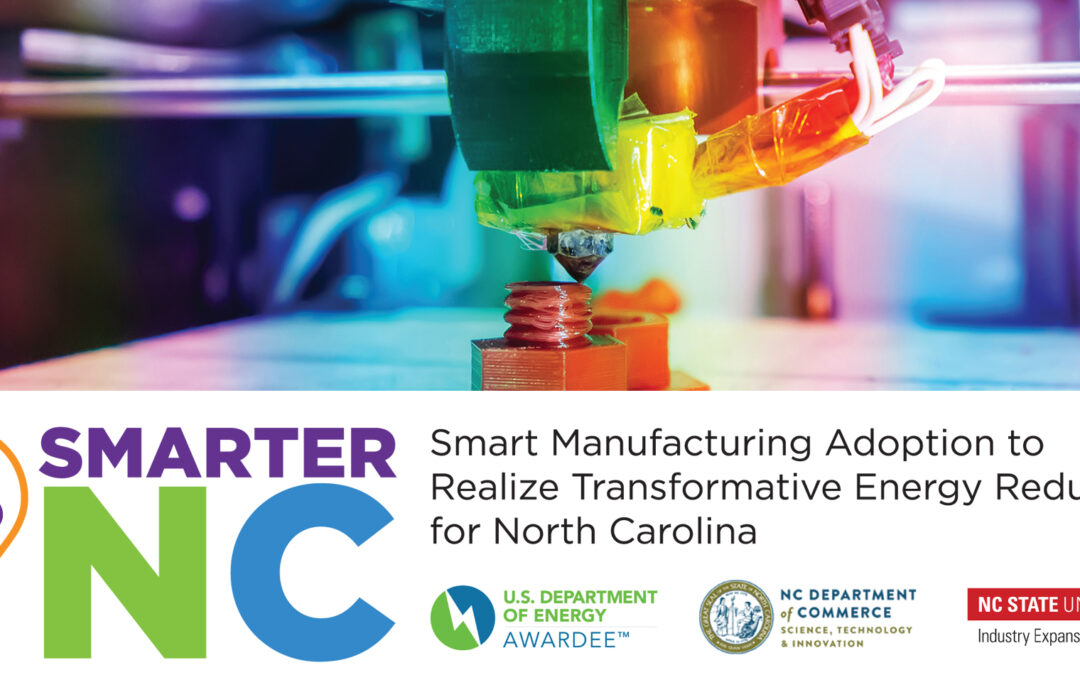
SMARTER NC

SMARTER NC Banner


Through a federal grant from the Department of Energy, we can provide financial assistance for small-to-medium sized manufacturers to offset some of the expenses of non-equipment costs to adopt and integrate relevant SMART technology.


The Benefits of Smart Manufacturing

Improved efficiency

Smart factories can monitor equipment performance and automate complex processes, improving accuracy and reducing human error.

Increased productivity

Smart factories can use data to identify issues, such as when a machine is slowing down production, and then use artificial intelligence systems to resolve them.


Long-term cost savings

Smart factories can use predictive maintenance to identify potential problems early and address them at a convenient time, which can save money.

Greater flexibility

Smart factories can scale production quickly to meet changing demand and can customize products to meet specific customer needs.


How the program works:

1.

Small-to-medium-sized (less than 500 employees) in North Carolina manufacturers will complete a short application (approximate time to complete is 10 minutes) to determine if their company is ready to participate in the program. ncstateies.com/sncapp

SUBMIT AN APPLICATION

2.

The SMARTER NC team will review applications. 100 initially qualified companies selected to participate will receive an initial walkthrough viability assessment. Assessment includes verification of application items, confirmation of production and energy systems, and collection of information concerning current and future commitments to smart manufacturing*.

*Important: The company should assign a smart manufacturing project decision-maker.

3.

From the initial 100 assessments, 75 small-to-medium-sized manufacturers will be approved to receive comprehensive smart manufacturing technical assessments to help develop implementation project ideas and strategies. Includes process assessments and energy assessments.* Results will be shared with the company to assist with their engagements with 3rd party integrators for a project solution plan and cost proposal.

Project solution plan and cost proposal are to be submitted SMARTER NC for approval of any reimbursements prior to project start. 50 projects will be approved for partial reimbursement of some project non-equipment costs.

*Funding priority will be given to higher energy use projects.

4.

The Department of Energy’s designated contracting officer, and the SMARTER NC team review the quote and agree to reimburse a matching level of non-equipment costs including integration and training expenses. Note: Participating companies must provide matching investment of at least 30% of project cost. Example: For a $20,000 smart manufacturing implementation project, SMARTER NC can approve reimbursement of up to $14,000. Maximum reimbursement to any company project is $25,000. Average reimbursements are expected to be ~$13,000.

Company completes the approved project with 3rd party and submits the agreed to reimbursement amount for payment.


To receive SMARTER NC reimbursement funds, approved applicants must:

  • Submit a detailed cost proposal for the SMARTER NC project subject to reimbursement including itemized labor and materials expenditures
  • Obtain a Unique Entity Identifier (UEI). This has replaced the Data Universal Numbering System (DUNS)number.
  • Have a procurement review process in place
  • Complete an environmental questionnaire as required by DoE
  • Receive documented evidence of approval by DOE and SMARTER NC
  • Submit evidence of paid invoices for the approved and completed SMARTER NC project
  • Complete approved SMARTER NC project and submit reimbursement request before March 15, 2027.

Target Industries
(but not limited to manufacturers in)

  • Biopharmaceutical
  • Metal Fabrication
  • Chemical and Polymer
  • Food and Beverage
  • Automotive and Heavy Equipment Manufacturing
  • Textiles

CONTACT US

US Department of Energy
NC Department of Commerce
Industry Expansion Solutions

Acknowledgment: This material is based upon work supported by the Department of Energy under Award Number DE-MS0000030.
Disclaimer: “This report was prepared as an account of work sponsored by an agency of the United States Government. Neither the United States Government nor any agency thereof, nor any of their employees, makes any warranty, express or implied, or assumes any legal liability or responsibility for the accuracy, completeness, or usefulness of any information, apparatus, product, or process disclosed, or represents that its use would not infringe privately owned rights. Reference herein to any specific commercial product, process, or service by trade name, trademark, manufacturer, or otherwise does not necessarily constitute or imply its endorsement, recommendation, or favoring by the United States Government or any agency thereof. The views and opinions of authors expressed herein do not necessarily state or reflect those of the United States Government or any agency thereof.”

Since 2017, the Office of Science, Technology & Innovation (OSTI), on behalf of the Board of Science, Technology & Innovation (BSTI), has had a special focus on the Data Economy a business ecosystem predicated on the digital transformation of operations, products, and services

"Data Economy" is a general term inclusive of big data, data science, and analytics. Leadership in the Data Economy is becoming increasingly critical, as more and more economic value is based on the ability to successfully collect and manipulate data for insight and profit.

To facilitate preparation of students in North Carolina to contribute to and thrive in the Data Economy, the BSTI, with support from the NC Office of Strategic Partnerships (OSP), has developed a visualization tool to map the distribution of data literacy pathways in Career and Technical Education (CTE) among high schools in North Carolina, as well as data-focused certificates and degree programs across community colleges, four-year colleges and universities in across the state.

The visualization tool’s intended users include (but are not limited to) educators, government agencies, elected officials, and business leaders. Created by Western Carolina University (WCU) professor Scott Barlowe, the tool is available at:


A link to documentation on explaining and illustrating how to use the tool is at the link above and Documentation

Additional background on the visualization tool's development is available at OSP's Project Portal. 

Additional information about the strategic importance of the Data Economy is available at Data Economy Press Release.

On This Page Jump Links
Off