
Disruptions to the Global Economy
As the situation in the Middle East continues to evolve, concerns are growing over its potential impact on the global economy. At the center of these concerns is the disruption to traffic through the Strait of Hormuz, a narrow waterway between Oman and Iran that connects the Persian Gulf to the Gulf of Oman and the Arabian Sea. By some estimates, roughly 27% of the world’s maritime trade in crude oil and petroleum products and 20% of global liquefied natural gas (LNG) pass through the Strait, making it one of the world’s most critical energy chokepoints.
Disruptions to energy supply chains have put upward pressure on prices for refined petroleum products such as diesel, gasoline, and jet fuel. At the same time, regional disruptions have restricted the flow of other raw materials, including fertilizers and helium, with downstream consequences for agricultural production and semiconductor manufacturing, among other end uses.
The full economic picture is still coming into focus, and conditions can change quickly. However, the effects are already being felt at the state level. To better understand what these disruptions could mean for North Carolina, this article examines the state’s trade relationships with several countries in the region and the key commodities involved.
A $1.2 Billion Export Market
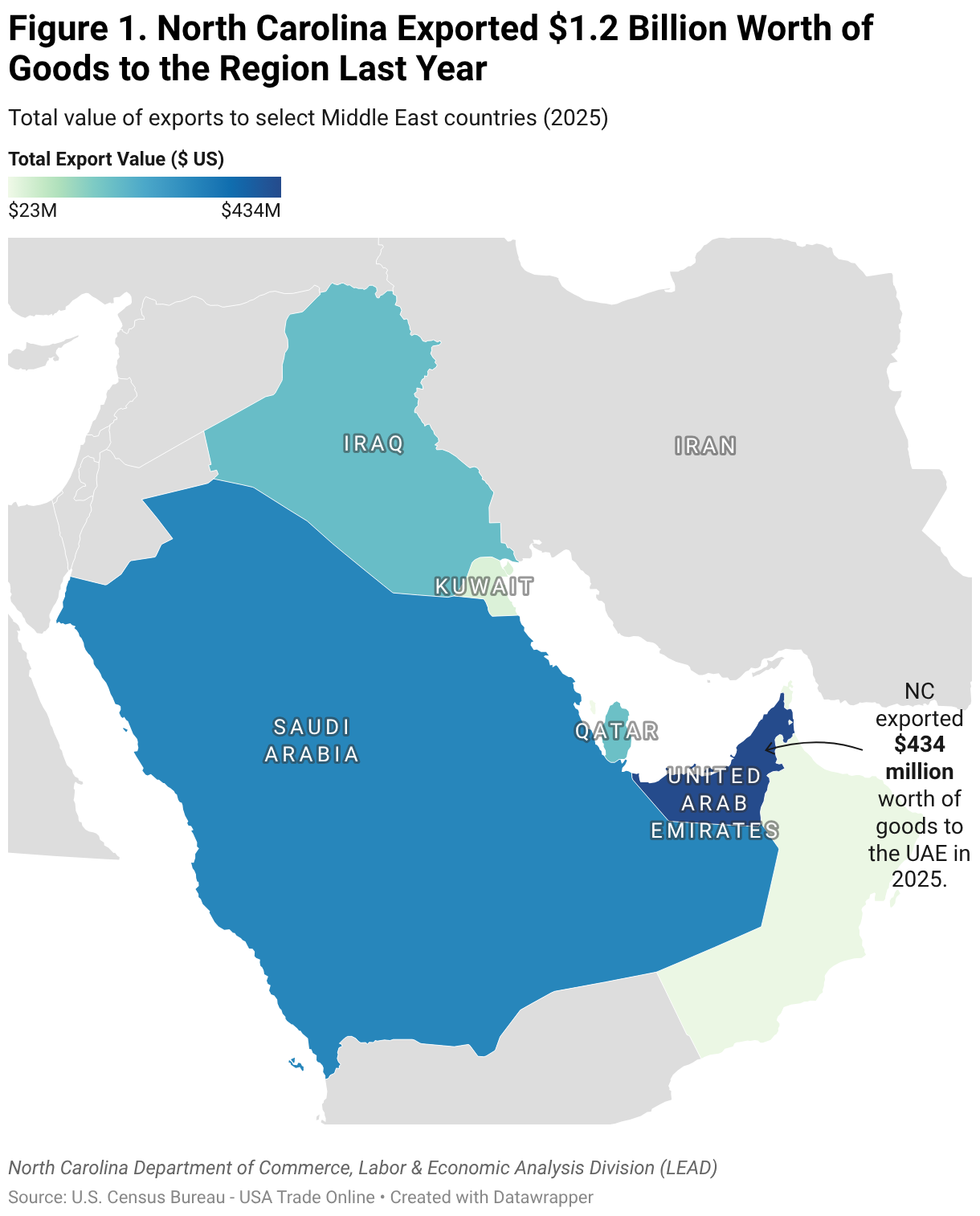
In 2025, North Carolina exported approximately $1.2 billion in goods to countries in the region.1 The United Arab Emirates (UAE) was the state’s top export destination, receiving $434 million worth of North Carolina goods, followed by Saudi Arabia ($304 million) and Iraq ($184 million) [Figure 1]. Qatar, Kuwait, Oman, and Bahrain accounted for the remaining share.
To put these figures in perspective, exports to this region represent 2.7% of North Carolina’s total exports worldwide. The state exports substantially more to other trading partners, including Canada, Mexico, and France.
Pharmaceutical products dominated North Carolina’s exports to the region, totaling $523 million in 2025. Other leading categories included electric machinery ($165 million), arms and ammunition ($142 million), industrial machinery ($113 million), and furniture and bedding products ($60 million) [Figure 2].

A $202 Million Import Market
North Carolina imported approximately $202 million in goods from the region in 2025, with Saudi Arabia serving as the largest source at $81 million in imports [Figure 3]. The UAE ($64 million) and Oman ($30 million) were second and third, respectively. Imports from this region account for just 0.2% of North Carolina’s total imports from all countries worldwide.

Organic chemicals were the top imported commodity, totaling $69 million in 2025. These inputs are essential to a range of manufacturing processes, including pharmaceutical and plastic production. North Carolina also imported $19 million in fertilizers last year, directly supporting the state’s agricultural production.

Uncertainty Ahead
While North Carolina's direct trade ties to the region are relatively modest, the state is not insulated from the broader economic consequences of a prolonged disruption to global energy and commodity markets. Businesses and consumers in the state may not experience outright shortages, but elevated prices are likely in the near term. Oil, fertilizer, helium, and other essential commodities are priced on global markets, meaning supply disruptions thousands of miles away can quickly raise the cost of everyday goods at home. Industries such as agriculture, chemical manufacturing, and computer and electronic product manufacturing in North Carolina may be particularly sensitive to these input cost pressures.
There is also the potential for indirect supply chain disruptions. For example, energy and helium shortages could slow production of semiconductor chips in Taiwan or South Korea, impacting data center construction and consumer electronic goods here in the U.S.
For an economy that has already weathered the COVID-19 pandemic, the Russia-Ukraine war, and tariffs, the current situation in the Middle East represents another source of economic uncertainty—one that bears close watching in the months ahead.
- 1
For this analysis, we focus on North Carolina’s international trade with seven Middle Eastern countries that have been particularly impacted by the disruptions to the Strait of Hormuz. These countries include the United Arab Emirates (UAE), Saudi Arabia, Iraq, Qatar, Kuwait, Oman, and Bahrain.