
North Carolina Employment Projections 2024 - 2034
Part 3: Regional Occupational Trends
As we conclude our three-part series on North Carolina’s 2024 - 2034 employment projections, we shift our focus to the Regional Occupational Projections. These projections estimate future workforce demand based on historical employment trends and a range of economic factors1 and offer valuable insights for shaping education and workforce planning in North Carolina.
This report highlights key findings from the 2024–2034 projections across North Carolina’s sixteen regions, covering overall employment trends and shifts in major occupational groups2.
Key Highlights:
- All sixteen regions are expected to add new jobs by 2034, with the fastest growth projected in the traditionally strong economic hubs of Raleigh-Durham, Charlotte, and Wilmington. In contrast, the Rocky Mount-Wilson region is projected to see the slowest growth with only 0.4% more jobs between 2024 and 2034.
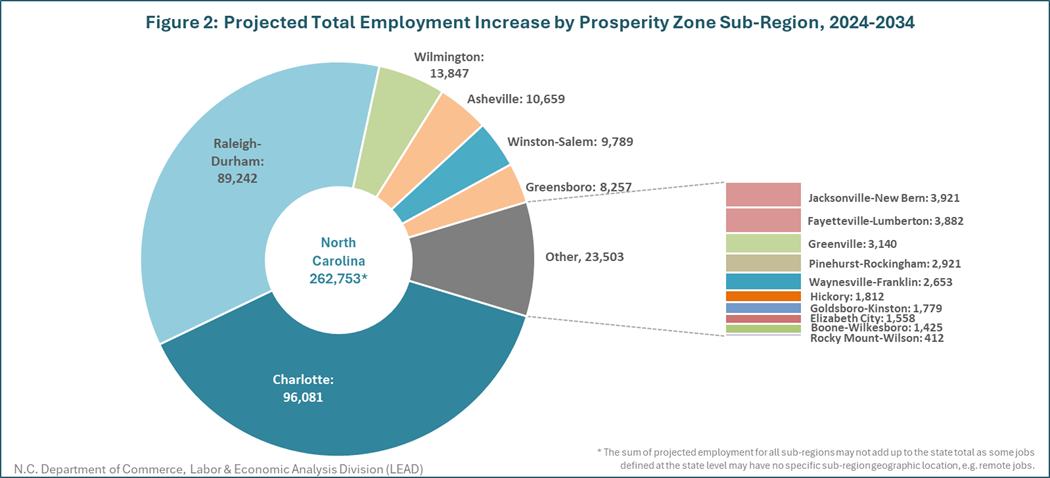
- More than one-third of the state’s new jobs are expected to be added in the Charlotte region alone, exceeding the combined total of all other Prosperity Zone sub-regions except Raleigh-Durham. While traditionally known for its financial sector, Charlotte is projected to capture four out of every ten new jobs statewide in both Computer and Mathematical Occupations and Business and Financial Operations Occupations.
- Over half of the net new jobs created in Charlotte, Fayetteville-Lumberton, Greensboro, Greenville, Hickory, Raleigh-Durham, and Winston-Salem are expected in occupations with a median annual wage of $50,000 or higher. For the remaining regions, most of the new jobs are projected to fall below the $50,000 wage level.
- Office and Administrative Support Occupations will show mixed trends — three largest regions (Raleigh-Durham, Charlotte, and Wilmington) are projected to gain jobs while the remaining regions are expected to see declines.
- Across multiple Prosperity Zone sub-regions, Food Preparation and Serving Related Occupations – typically lower-paying and high-turnover jobs – are projected to be the largest in both net new jobs and annual job openings. Depending on the region, these occupations are expected to account for between 9% (Charlotte) to 44% (Boone-Wilkesboro) of all net new jobs created between 2024 and 2034.
- In every region, jobs requiring at least some post-secondary education are projected to grow faster than those requiring lower educational attainment. However, more than half of all net new jobs across all regions are expected to require no formal education or only a high school diploma for entry into the occupation.
- In Charlotte and Raleigh-Durham, 11% of annual job openings are projected to pay median annual wages above $100,000 over the projection period.
Total Employment
For the 2024-2034 period, overall employment is projected to expand in all Prosperity Zone sub-Regions, ranging from 0.4% in Rocky Mount-Wilson to 7.1% in Raleigh-Durham and Charlotte (Figure 1).
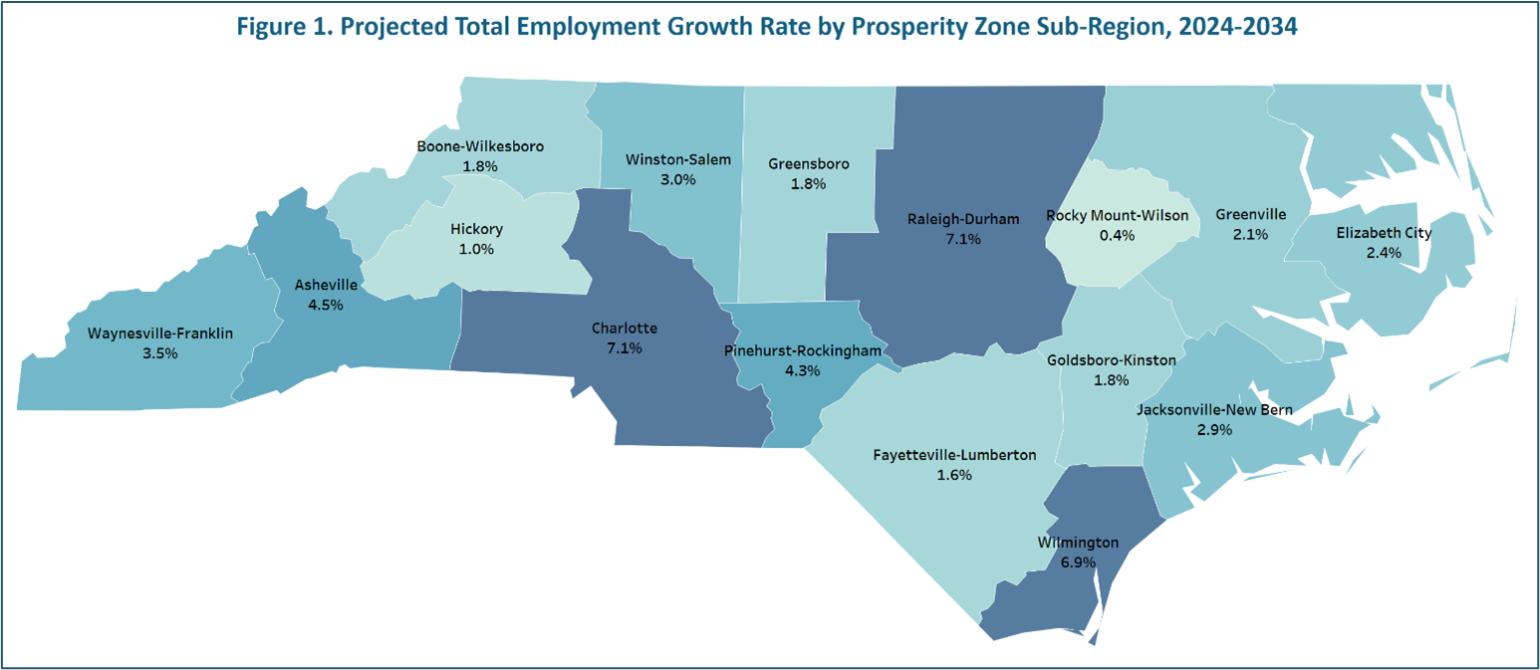
The largest job gains are projected in Charlotte and Raleigh-Durham, with approximately 96,100 and 89,200 new jobs, respectively (Figure 2). These two regions are also expected to be among the fastest-growing in the state, with projected employment increases of 7.1% for each region by 2034. Wilmington, which has the seventh-largest workforce among all sub-regions, is expected to add more than 13,800 jobs – a 6.9% increase by 2034.
Major Occupational Groups
Table 1 shows occupational employment projections in percentage change over the 2024-2034 period.
- Raleigh-Durham, Charlotte, and Wilmington are projected to see highest percentage growth rates across most major occupational groups.
- Office and Administrative Support occupations; Sales and Related occupations; Food Preparation and Serving Related occupations; and Transportation and Material Moving occupations consistently represent the four largest employment groups across most sub-regions and are expected to remain so through 2034. However, these groups are projected to experience very different growth trajectories over the next decade (Table 1).
- Office and Administrative Support occupations are expected to decline across the state. Employment in this group is expected to grow modestly in only three of the sixteen regions – Charlotte (+0.5%), Raleigh-Durham (+0.1%), and Wilmington (+1.1%). The remaining thirteen regions are projected to see declines, with the steepest decreases in Rocky Mount-Wilson (-6.7%) and Goldsboro-Kinston (-6.1%).
- Sales and Related occupations are projected to experience varying trends across the state. The four growing regions are expected to be Wilmington (+3.3%), Charlotte (+2.5%), Raleigh-Durham (+2.5%), and Waynesville-Franklin (+0.4%). However, the remaining regions are projected to see declines with the largest decreases projected in Rocky Mount-Wilson (-4.1%).
- Food Preparation and Serving Related occupations are projected to add jobs in all sixteen regions, driven by population growth. Net new job growth is expected to range from 1.5% in Rocky Mount-Wilson to 8.0% in Raleigh-Durham.
- Transportation and Material Moving occupations are projected to add jobs in all regions. Job growth for this occupation group is expected to range from 2.1% in Rocky Mount-Wilson to an 8.9% increase in Wilmington.
Table 1. Regional Employment Projections (Total % change) by Major Occupational Group, 2024-2034
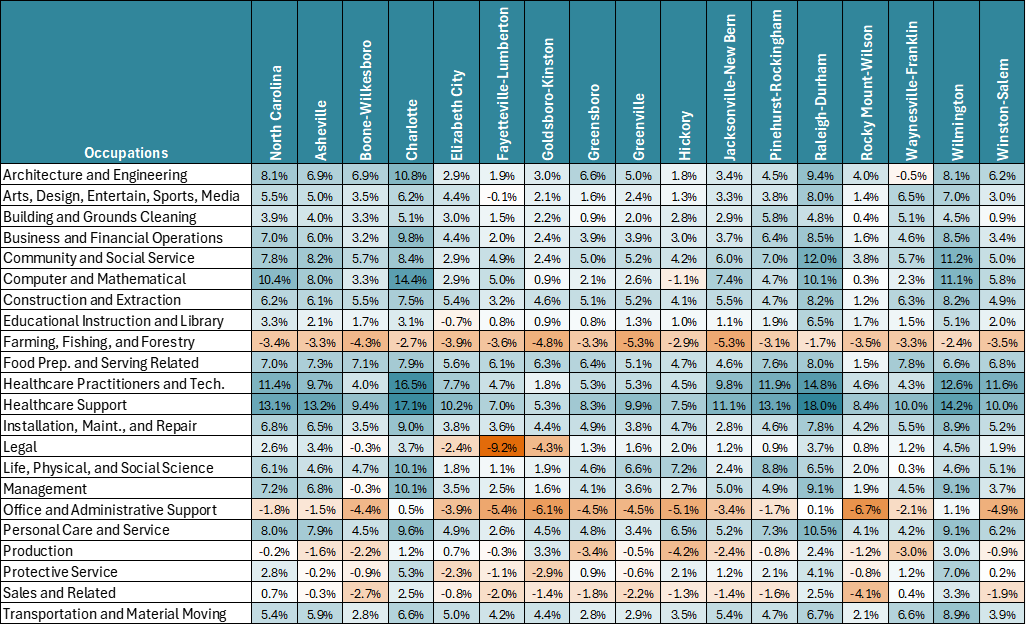
- Healthcare Support occupations and Food Preparation and Serving Related occupations are projected to be the fastest-growing occupational groups in most regions.
- Production occupations are expected to see uneven growth across the state. Five regions are projected to add jobs in this sector, while the remaining eleven are expected to experience declines.
- Farming, Fishing, and Forestry occupations are projected to decline significantly in all regions over the next decade.
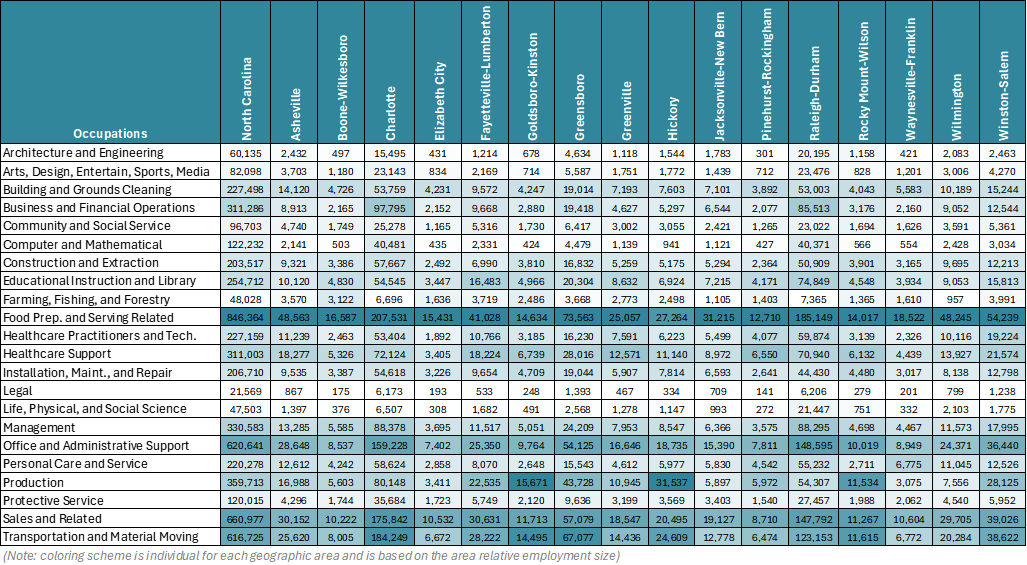
In addition to projecting overall employment changes, the occupational employment projections estimate job openings resulting from labor market turnover. These projections account for occupational separations—when workers either exit the labor force or change occupations, creating openings for replacement. For most occupations, separations generate significantly more job openings than employment growth alone. In fact, even declining occupations may still see numerous annual openings.
As shown in Table 2, occupations with traditionally high turnover rates and lower wages — such as Food Preparation and Serving Related, Transportation and Material Moving, and Office and Administrative Support — are expected to have high numbers of job openings across all regions.
Table 2. Projected Regional Job Openings by Major Occupational Group, 2024-2034
Educational Attainment
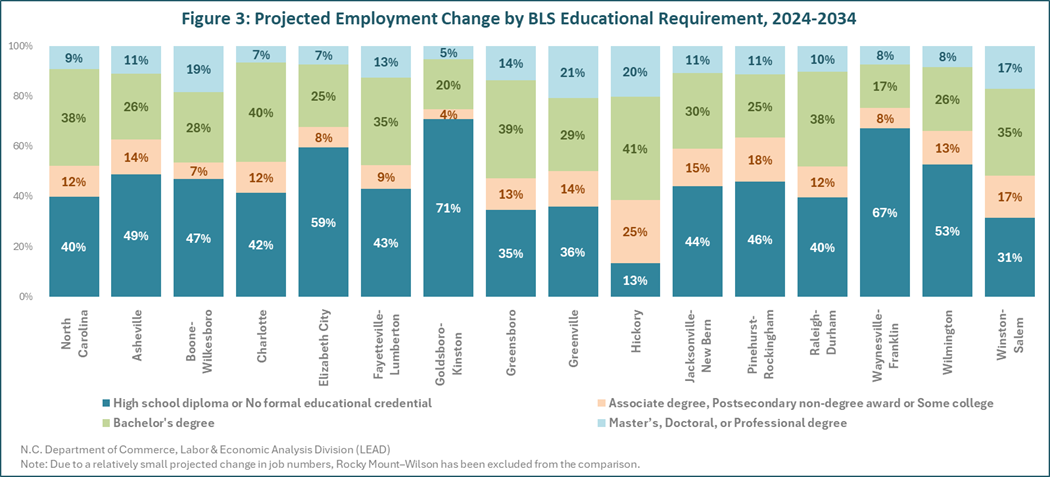
For most net new jobs across all regions, the minimum entry-level education requirement3 will be No Formal Education or a High School Diploma, the majority of net new jobs in all regions will require No Formal Education or only a High School Diploma. However, there are notable regional differences (see Figure 3), ranging from 13% in Hickory to 71% in Goldsboro-Kinston.
The highest demand for occupations typically requiring a Bachelor’s Degree is projected in Raleigh-Durham (38% of all net new jobs projected), Charlotte (40%), and Hickory (41%). However, Hickory's figure is largely an anomaly, driven by a sharp projected decline in jobs requiring High School Diploma rather than exceptional growth in Bachelor's-level positions.
Jobs requiring a Master’s, Doctoral, or Professional degree will account for approximately 5% to 21% of net new positions, with the greatest demand expected in Hickory (20%) and Greenville (21%).
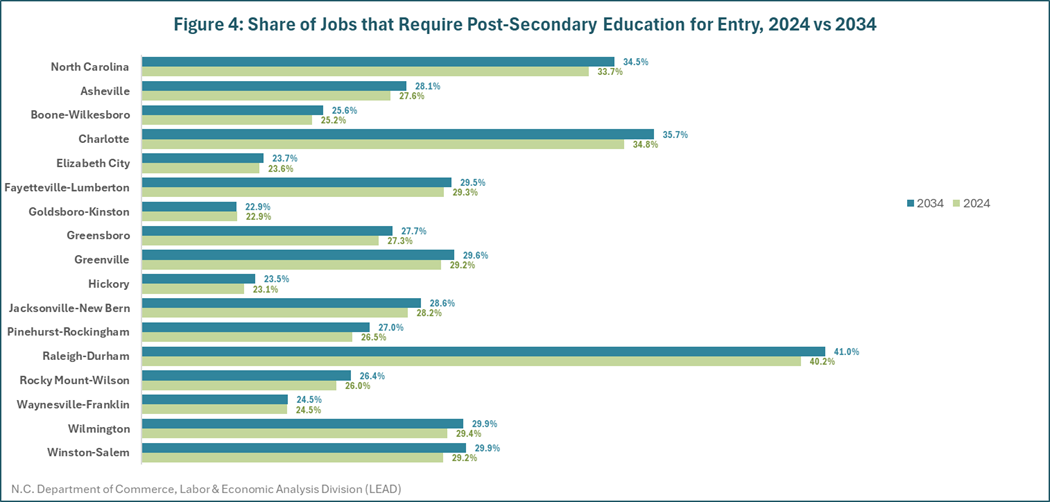
As growth rates and numbers of jobs with different entry-level educational requirements are expected to change, so will the composition of North Carolina’s labor force. Figure 4 illustrates projected changes in the share of jobs requiring at least some post-secondary education between 2024 and 2034.
In fourteen of sixteen regions, the share of jobs requiring post-secondary education is projected to increase over the next decade. The exception is Goldsboro-Kinston which is projected to see a small decrease in the share of jobs that require at least some post-secondary education.
Raleigh-Durham, the state's knowledge economy hub, traditionally leads all regions in post-secondary job share (40.2% in 2024, rising to 41.0% by 2034).
Wages and Compensation
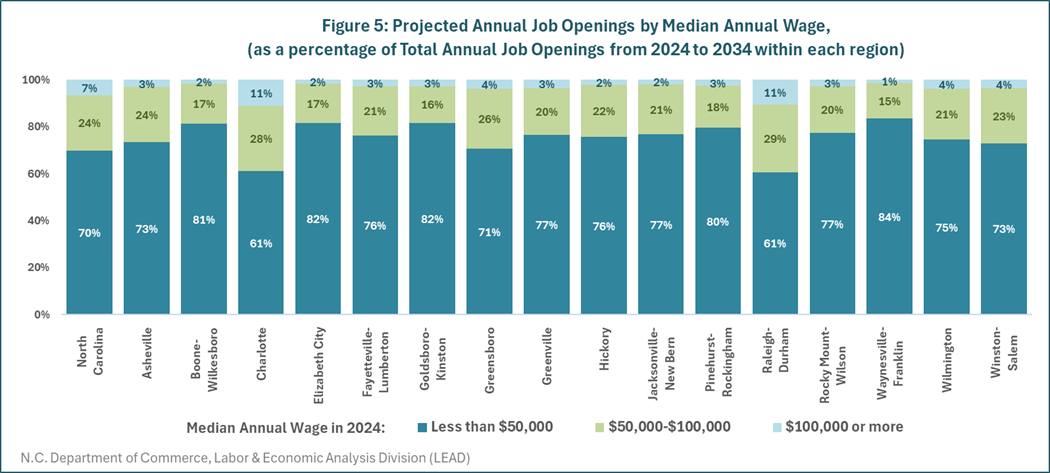
In eleven regions, more than three-quarters of annual job openings are projected to have a median annual wage below $50,0004 (see Figure 5). Waynesville-Franklin, Elizabeth City, and Goldsboro-Kinston are expected to have the highest shares of these lower-wage job openings.
In contrast, five regions – Asheville, Charlotte, Greensboro, Raleigh-Durham, and Wilmington – are projected to have a quarter or more of annual job openings with median annual wages above $50,000. Charlotte and Raleigh-Durham particularly stand out, with 11% each of their annual job openings projected to pay median annual wages above $100,000 over the projection period.
To further explore LEAD’s 2034 employment projections, visit the projections data table or the Occupational Projections dashboard.
- 1
Projections assume full employment for the economy in the projected year, thus the projections are not intended to be an economic forecast of future employment.
- 2
Statewide and regional projections for the 2024-2034 period are available at https://analytics.nccommerce.com/projections/occ/.
- 3
https://www.bls.gov/emp/tables/education-and-training-by-occupation.htm
- 4
All wage figures are based on the OEWS annual estimates for 2024. Median annual wage in North Carolina in 2024 was $46,950 across all occupations (https://d4.nccommerce.com/OESSelection.aspx).
This page was last modified on 04/07/2026