

Over 460,000 North Carolinians work in the Manufacturing sector, and advanced manufacturing was identified as a key workforce sector in the Governor’s Council on Workforce and Apprenticeships’ Strategies to Advance North Carolina’s Workforce Development Progress. In recognition of Manufacturing Month, this article uses data from the Common Follow-up System (CFS) to examine the educational and employment outcomes of graduating Manufacturing Career and Technical Education (CTE) Concentrators from North Carolina’s public high schools.
North Carolina’s CTE program prepares middle and high school students for college, careers, and the workforce by combining academic learning with practical, career-focused skills development. A CTE Concentrator is a student who has successfully completed a designated concentrator course within an approved CTE career pathway. Manufacturing-related CTE in North Carolina is primarily represented within the state's Advanced Manufacturing cluster and related pathways.
Manufacturing CTE Graduates Reach a Record High
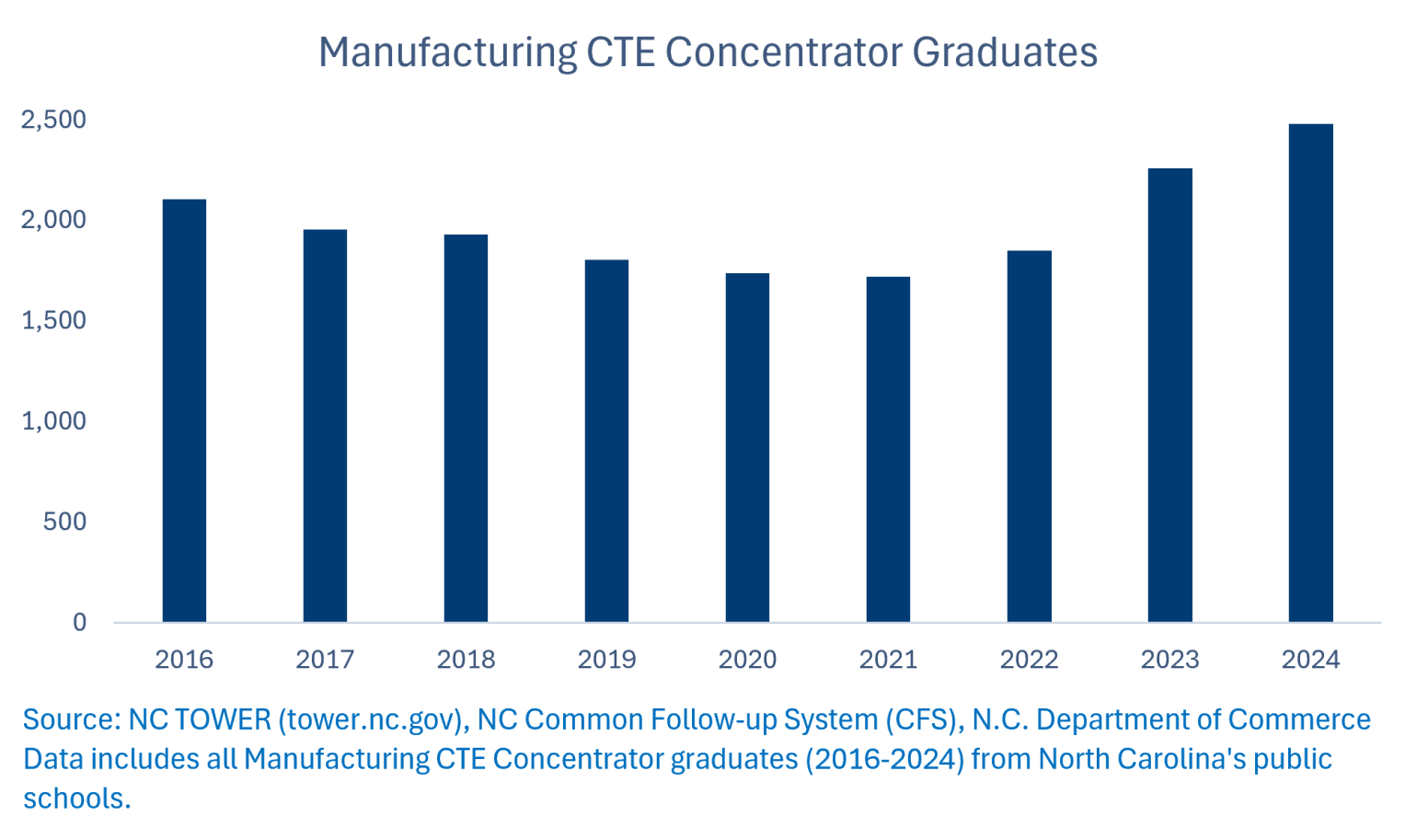
The number of Manufacturing CTE Concentrator graduates declined gradually from 2,105 in 2016 to 1,720 in 2021. Since then, the number increased each year, reaching a record high of 2,478 in 2024. While these data do not identify the factors behind the decline and subsequent increase, the recent growth represents a notable shift from the downward trend observed between 2016 and 2021. The number of graduates between 2016 and 2024 is presented in Figure 1.
Figure 1
Manufacturing CTE Concentrator Graduates, 2016 to 2024
Postsecondary Enrollment Rates Declined
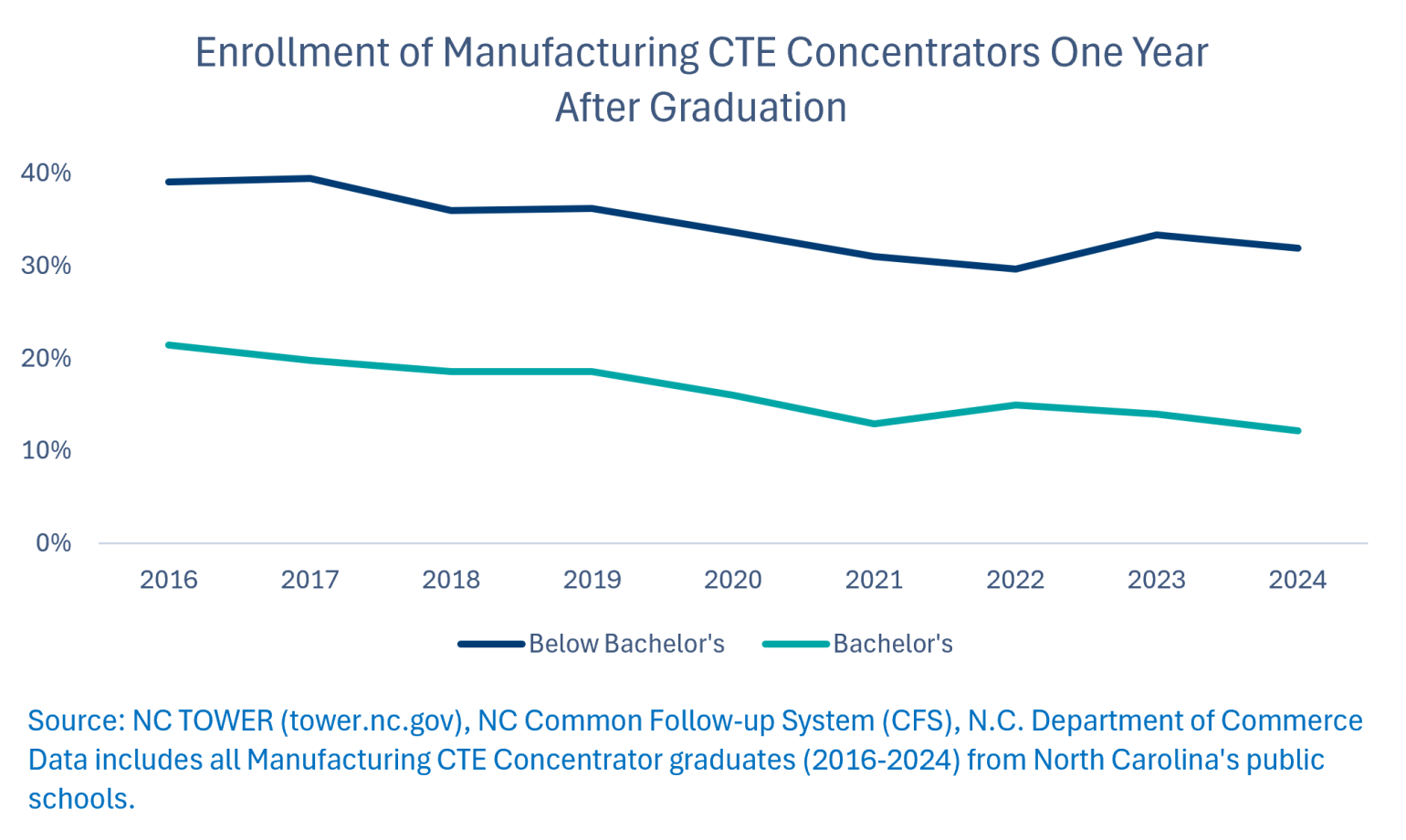
The share of Manufacturing CTE Concentrator graduates enrolling in postsecondary education immediately after high school declined over the period, from 61 percent of the 2016 cohort to 44 percent of the 2024 cohort.
Below-bachelor’s programs remained the most common postsecondary pathway for Manufacturing CTE Concentrator graduates. During the first year after high school, roughly one in three graduates enrolled in a program leading to a diploma, certificate, or associate degree at a North Carolina community college or an out-of-state institution. A smaller share, 21 percent in 2016 and 12 percent in 2024, enrolled in bachelor’s degree programs.
Figure 2
Below Bachelor’s and Bachelor’s Enrollment of Manufacturing CTE Concentrator Graduates One Year Following Graduation
Employment was Not Limited to Manufacturing
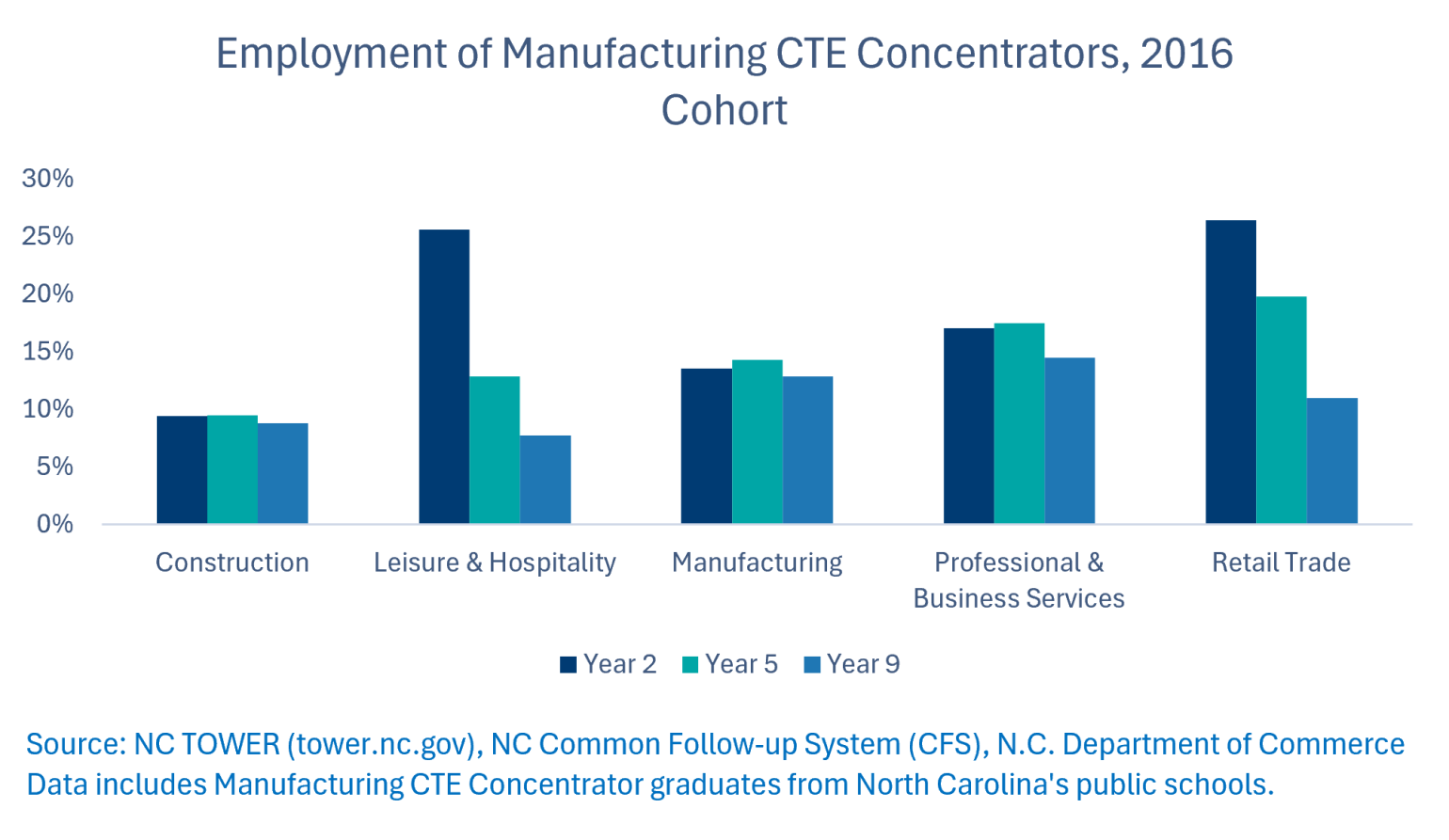
Manufacturing CTE Concentrators who chose to enter the workforce two years following graduation entered a diverse range of industries, demonstrating that completion of a Manufacturing program does not lead exclusively to employment in the Manufacturing sector. For the 2016 cohort, the Retail Trade and Leisure & Hospitality sectors – two sectors where employment among new graduates is common – were particularly prominent early in graduates' careers but declined over time.
Employment in the Manufacturing, Construction, and Professional & Business Services sectors showed greater persistence. Manufacturing was the second largest of the reported employment sectors in year nine, indicating a relationship between CTE concentration and sector of employment.
Figure 3
Manufacturing CTE Concentrators’ Employment, Selected Years Following Graduation, 2016 Cohort
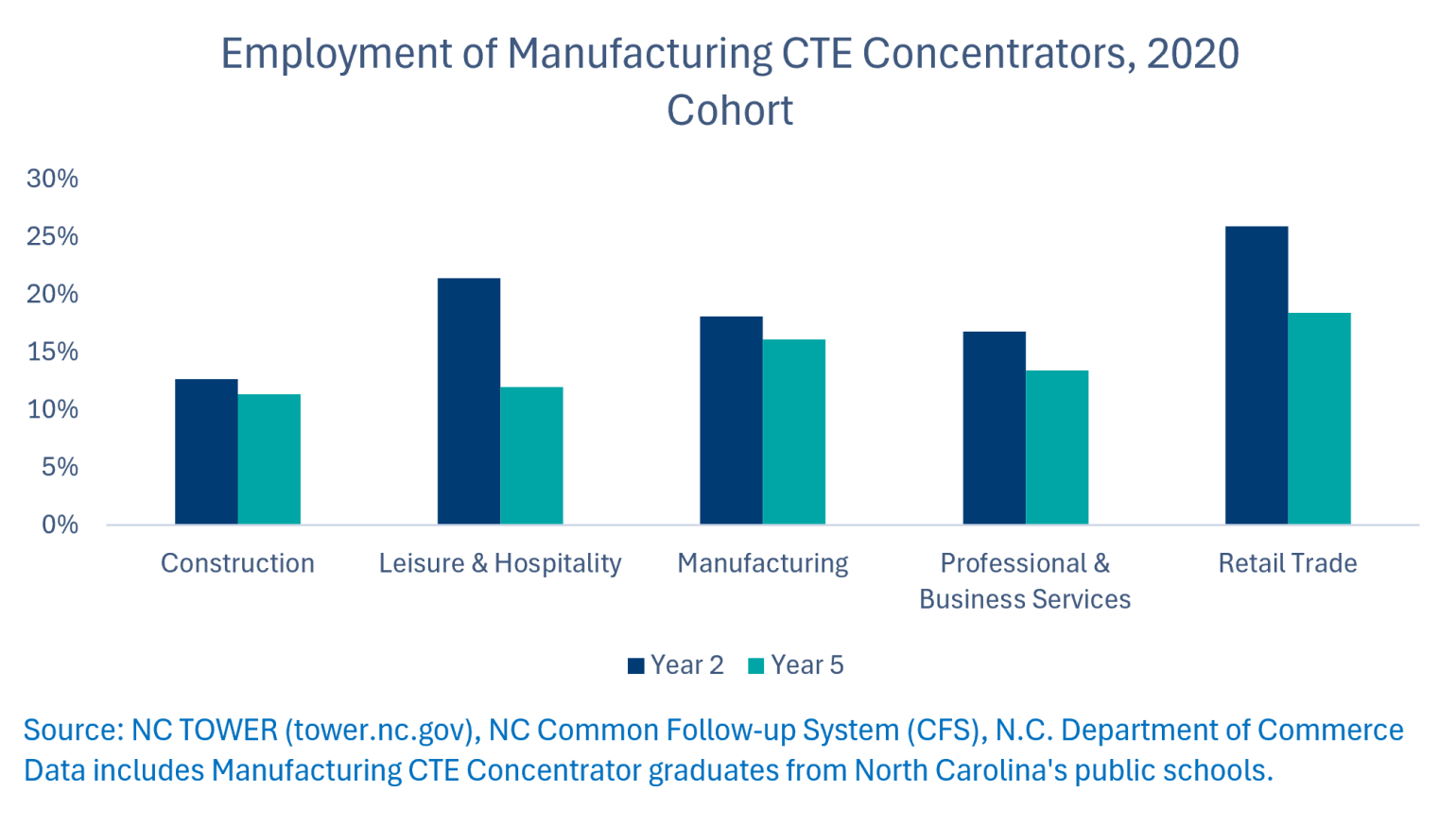
For the 2020 cohort, Manufacturing remained a significant employment sector, but the Retail Trade sector was the largest employer for this group, accounting for 26 percent of graduates in year two and 18 percent of graduates in year five. About 18 percent of graduates were employed in the Manufacturing sector in year two and 16 percent in year five. Construction, Leisure & Hospitality, and Professional & Business Services remained significant employment sectors, as well.
Skills developed through Manufacturing CTE may be transferrable to occupations across a range of sectors. These employment patterns provide insight into the industries employing Manufacturing CTE graduates, but do not necessarily indicate whether graduates are working in occupations related to their CTE training.
Figure 4
Manufacturing CTE Concentrators’ Employment Selected Years Following Graduation, 2020 Cohort
Average Annual Wages Highest in Construction and Manufacturing
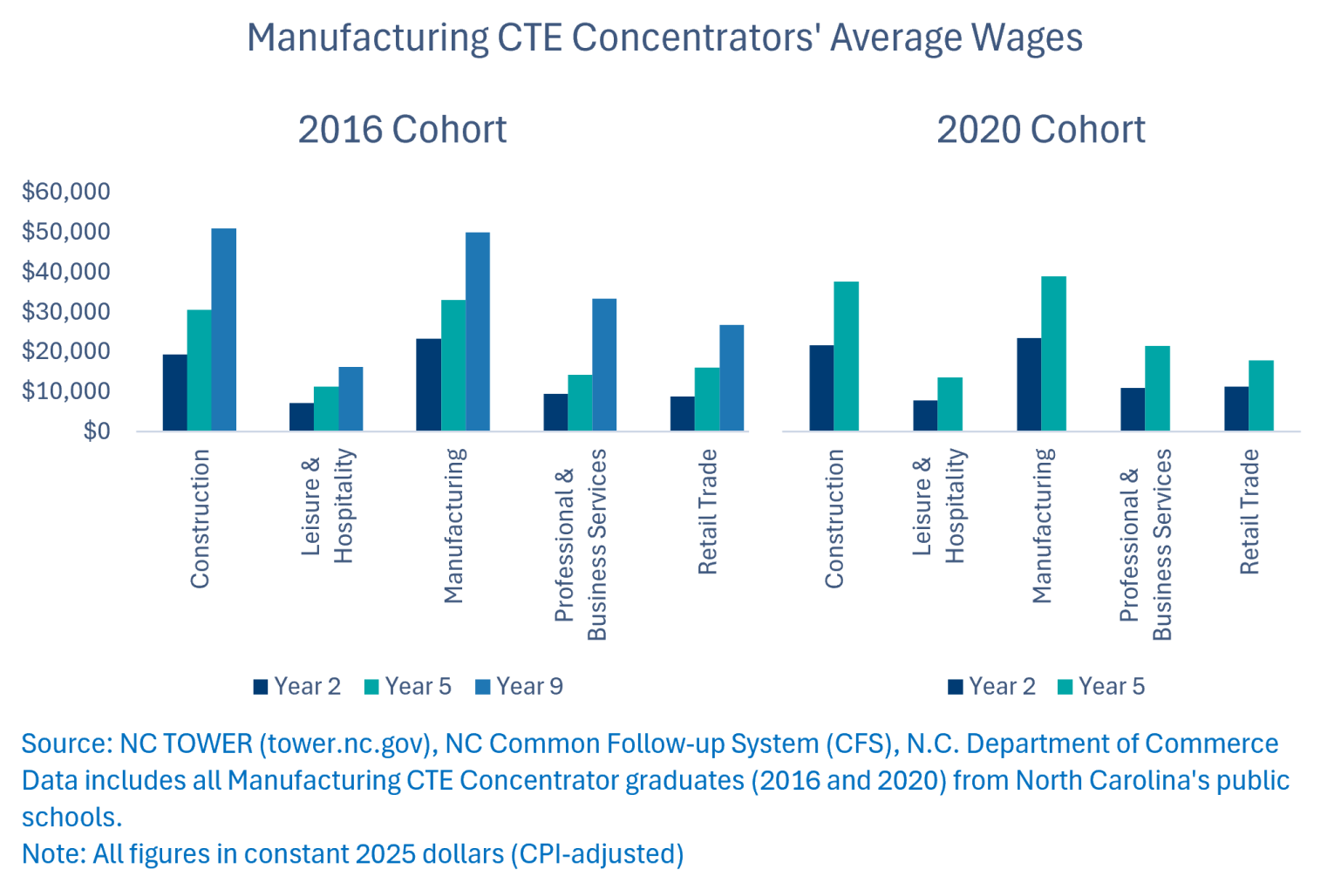
Graduates employed in the Construction and Manufacturing sectors earned the highest average annual wages1 at two, five, and nine years after graduation. Wages increased substantially as graduates accumulated labor market experience, particularly in the Construction, Professional & Business Services, and Manufacturing sectors.
Manufacturing had the highest average wages for both cohorts in years two and five, while Construction surpassed Manufacturing by year nine for the 2016 cohort. Average wages were lower in Leisure & Hospitality, Professional & Business Services, and Retail Trade.
Figure 5
Average Annual Wage of Manufacturing CTE Concentrators, Selected Years Following Graduation
Participation in Manufacturing CTE has grown in recent years, and the data show that Manufacturing CTE Concentrators follow diverse education and career pathways, with Manufacturing an important and relatively high-paying employment sector. These findings support the potential role of Manufacturing CTE in North Carolina’s broader efforts to develop the skilled workforce needed to support advanced manufacturing. Manufacturing CTE can play an important role in connecting secondary and postsecondary training, industry credentials, and employment. Understanding how Manufacturing CTE students transition to postsecondary education and the workforce can help educators, employers, and policymakers identify opportunities to strengthen the state’s talent pipeline.
- 1
All figures in constant 2025 dollars (CPI-adjusted)