

The Impact of Registered Apprenticeships
Registered apprenticeships and other forms of work-based learning have become a central priority of North Carolina’s workforce development strategy, with the Governor’s Council on Workforce and Apprenticeships setting an ambitious goal to double the number of registered apprentices statewide. Apprenticeships follow an “earn-and-learn” model, allowing participants to earn a paycheck while gaining valuable skills through on-the-job training and classroom instruction. Upon successful completion, apprentices earn a portable, nationally recognized credential.
Previous LEAD research has shown that registered apprenticeships have a positive, causal impact on laid-off workers, resulting in higher rates of employment and higher earnings for nearly a decade after job loss. But do registered apprenticeships produce similar benefits for other populations? In this article, we examine the impact of registered apprenticeships on recent high school graduates, tracking how participation affects employment and earnings over a ten-year period.
Our study uses data from the Common Follow-up System (CFS), which contains information on individuals who have received publicly funded education, training, and other workforce services in North Carolina. The CFS also includes employment and earnings data on individuals working in jobs covered by North Carolina’s unemployment insurance (UI) laws.1
We examine a group of 450 public high school graduates from 2000 to 2014 who enrolled in a registered apprenticeship program within one year of graduation. We then compare their labor market outcomes to a group of graduates with similar academic, demographic, and economic characteristics, but who did not enroll in an apprenticeship. In other words, the only measurable difference between these two groups was participation in a registered apprenticeship program after high school. This “apples-to-apples” comparison allows us to estimate the causal impact of registered apprenticeships (see the Appendix for a full methodology).
Higher Rates of Employment
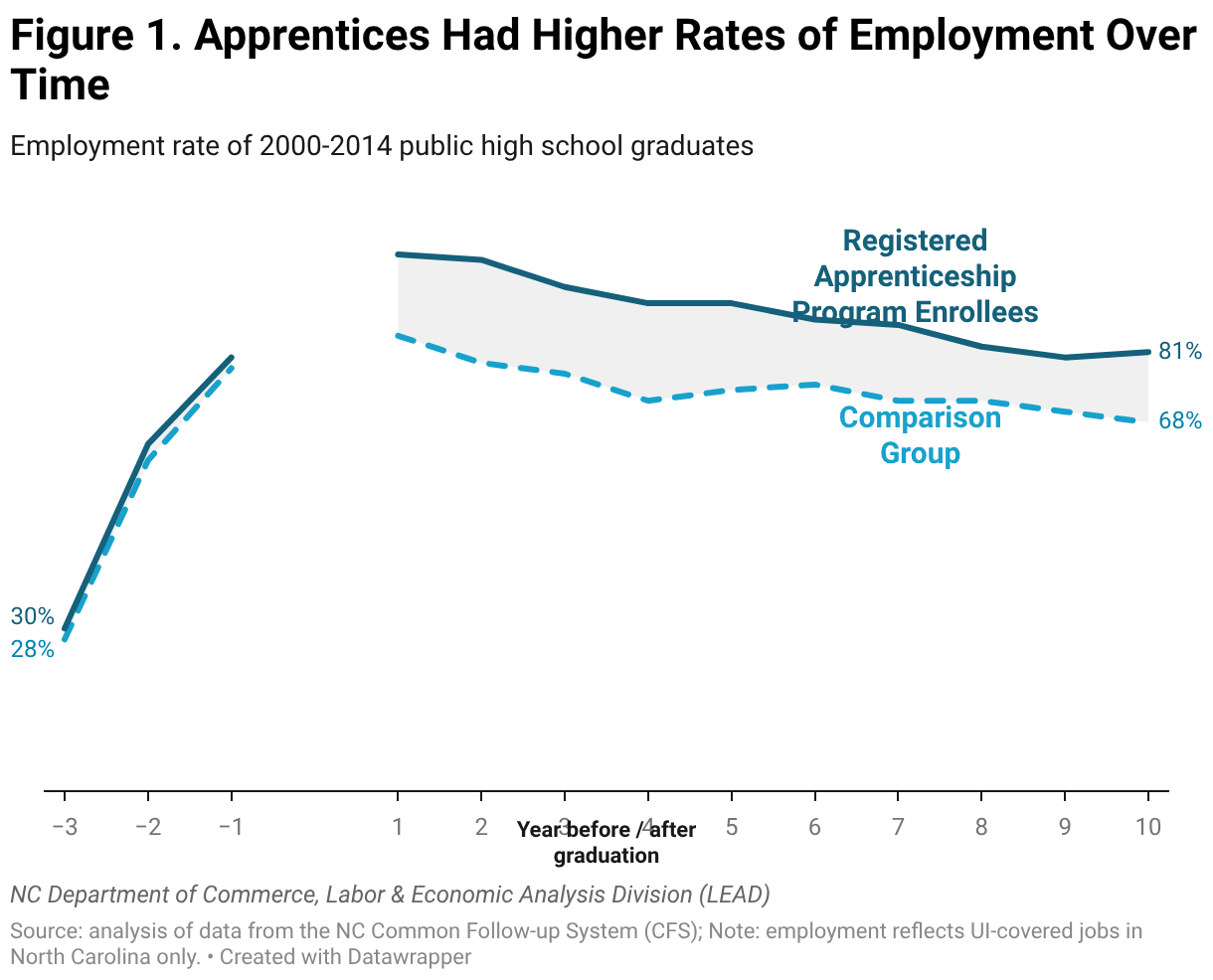
Registered apprentices and individuals in the comparison group had nearly identical rates of formal UI-covered employment in North Carolina during the three years leading up to high school graduation [Figure 1]. However, these employment rates began to diverge in the years following high school, when individuals enrolled in a registered apprenticeship program. By the fifth year after graduation, the employment rate among apprentices reached 90%, compared to 74% of non-enrollees. A decade after graduation, apprentices maintained an employment rate of 81%, roughly 13 percentage points higher than the comparison group.
Higher Wage Earnings
Among those who found work, apprentices earned more than their peers for at least a decade after high school [Figure 2]. Five years after graduation, apprentices earned an average of $14,500 more annually than non-enrollees (in 2025 dollars). Ten years after graduation, the difference in earnings remained sizeable, with apprentices earning an average of $9,000 more per year.

Higher Rates of Employment in Construction and Manufacturing
Apprentices were more likely to work in higher-paying sectors, such as Construction and Manufacturing, which partly explains the earnings gap observed above. In the fifth year after graduation, 26% of employed apprentices worked in the Construction sector, compared to only 9% of non-enrollees [Figure 3]. Similarly, 25% of employed apprentices worked in the Manufacturing sector, compared to 11% of their peers. In contrast, non-enrollees were more likely to be employed in lower-paying sectors, such as Retail Trade or Accommodation and Food Services.
While Figure 3 focuses on the fifth year after graduation, we find a similar distribution of sector employment in the tenth year, suggesting that apprentices continue to work in Construction and Manufacturing at higher rates over the long term.

As North Carolina works to double the number of registered apprentices statewide, these findings offer rigorous evidence that the benefits of apprenticeships extend beyond displaced workers, delivering meaningful gains in employment and earnings for recent high school graduates that last at least a decade.
Appendix: Data and Methodology
This study uses data from the North Carolina Common Follow-up System (CFS), a longitudinal repository of workforce data on participants in public employment, training, and education programs going back to the late 1990s. The CFS also contains employment and wage-earning information for all individuals working in unemployment insurance (UI)-covered jobs in North Carolina.
The study cohort consists of NC Department of Public Instruction (DPI) students who graduated between 2000 and 2014 and enrolled in a registered apprenticeship program within one year of graduation. The comparison group consists of DPI graduates who did not enroll in a registered apprenticeship program.
Program impacts are estimated using a matched comparison group design. The comparison group is matched to the treatment group—apprenticeship enrollees—on individual-level attributes predictive of program participation, including sex, race and ethnicity, age at graduation, local education agency (LEA), career and technical education (CTE) concentration status, disability status, academic giftedness, and employment in the three years prior to high school graduation.
The main findings are estimated using one-to-one nearest-neighbor propensity score matching with replacement, with each apprenticeship enrollee matched to the comparison group observation with the most similar predicted likelihood of program participation.
Impacts are estimated for each year following graduation, up to ten years later, and consist of: (i) employment in a UI-covered job in North Carolina and (ii) average UI-covered wage earnings in North Carolina, adjusted to 2025 dollars. Sensitivity tests were conducted to assess the robustness of the main findings, including regression adjustment and difference-in-differences estimation.
- 1
Employment and earnings in this article are measured using North Carolina's unemployment insurance (UI) wage records, which cover most formal, paid employment in the state. Employment not covered by the state’s UI law includes the self-employed, federal government employees, military service members, religious organization employees, summer camp employees, and any employment outside of North Carolina.