

Welcome to the April 2026 edition of NC Economy Watch: an update on what’s happening in the North Carolina economy and what it means for you, brought to you by the Labor & Economic Analysis Division (LEAD) of the NC Department of Commerce.
In this edition of NC Economy Watch, we examine the employment data revisions just released by the US Bureau of Labor Statistics. Like last year, this year’s revisions point to a widespread labor market slowdown, with most of North Carolina’s industry sectors and metro areas seeing downward revisions. In addition, these revisions show the Asheville area experiencing a persistent shortfall in employment following the impact of Hurricane Helene, demonstrating the challenges faced by Western North Carolina in achieving a complete economic recovery.
Data Revisions Point to a Widespread Labor Market Slowdown
We’re nothing if not consistent. If you’ve followed our NC Economy Watch series, you know that North Carolina recently entered the fifth consecutive year of a prolonged labor market slowdown that shows few signs of abating. You may also know that the US Bureau of Labor Statistics revises key labor market indicators on an annual basis, with data revisions in recent years often revealing that job growth has been slower than initially estimated.
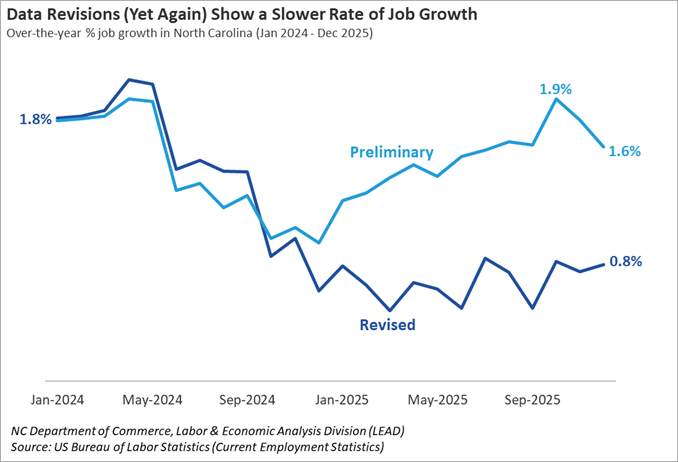
The most recent set of annual data revisions published this morning tell a story that should be familiar to readers of this series. Preliminary employment estimates for North Carolina seemed to indicate accelerating growth in 2025, with over-the-year job growth rates approaching 2% [Figure 1]. The revised data published today show this apparent acceleration to be a mirage, with growth rates in fact remaining below 1% throughout the year.
Figure 1
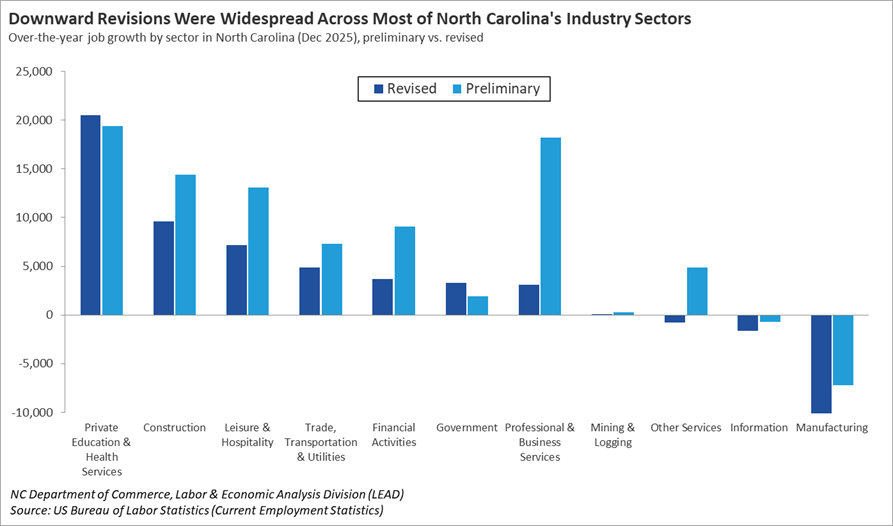
Sector-level employment figures also reflect what we experienced during the previous annual cycle of data revisions. Job growth in the Private Education & Health Services sector was revised upward and remained by far the largest source of net new jobs in North Carolina [Figure 2]. Job growth in the Manufacturing sector was revised downward and remained by far the largest source of net job losses. Employment gains in Professional & Business Services were revised downward by over four-fifths, showing essentially flat growth over the year. Nine out of North Carolina’s 11 major industry sectors saw negative revisions.
Figure 2
Negative revisions were also widespread across most of North Carolina’s metro areas, with nine out of 15 showing a slower rate of job growth than initially estimated. Revisions in the Charlotte-Concord-Gastonia metro area were particularly impactful. Before today’s revisions were published, Charlotte was thought to have among the fastest rates of job growth in the country. However, revised data show that Charlotte-area employment grew only 1.2% over the year as of December 2025, much lower than the preliminary estimate of 2.7% and among the lowest growth rates Charlotte has ever seen outside of a recession.
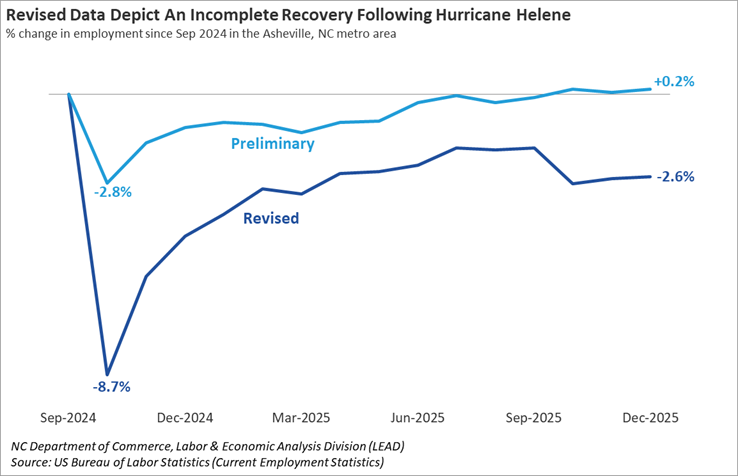
In September 2025, we shared evidence that Western North Carolina had experienced larger job losses following Hurricane Helene than initially estimated. Today’s revisions make it official: the Asheville metro area was hit hard by Helene and is currently facing an incomplete recovery. Total nonfarm employment in the Asheville area plummeted nearly 9% in October 2024, versus only around 3% in the preliminary estimates [Figure 3]. Early data showed encouraging signs of recovery, with employment returning to its pre-hurricane level in October 2025, but the revised data indicate a persistent shortfall. Employment in the Asheville area remained around 3% below its pre-hurricane level as of December 2025, hardly budging from the levels reached during its nascent spring rebound, demonstrating the challenges faced by Western North Carolina in achieving a complete economic recovery.
Figure 3
We write about these revisions every year not only to update your understanding of labor market trends, but also to promote data literacy among our readers. Many data users crave “real-time data” that offers instantaneous answers to timely questions about current economic conditions. Unfortunately, the fastest data are seldom the most accurate. Quality data collection takes time, and we typically need to wait weeks, months, or even years to get an accurate reading on what’s really happening in the world around us.
So, what can you do to avoid getting caught flat-footed by potentially misleading preliminary data? If you have questions about employment, focus on higher-quality data sources like the Quarterly Census of Employment and Wages (QCEW). While these data are typically lagged by around five-to-seven months, they provide a much more accurate count than the preliminary, survey-based Current Employment Statistics (CES) estimates that are reported in the news media every month. In fact, the annual revisions to CES estimates are largely based on data from QCEW, and you can anticipate upcoming CES revisions by following QCEW data releases on a quarterly basis.
In general, it’s best to consult several different data sources at once, since they all have relative strengths and weaknesses and no one data source can offer a comprehensive description of all the complexities of our economy. But for those who don’t have the time or patience to dig through reams of economic statistics, the best thing you can do is to stay tuned to NC Economy Watch as we continue to assess the incoming figures and break down what they mean for jobseekers, employers, and the workforce professionals who serve them.
For inquiries and requests, please contact:
Meihui Bodane, Assistant Secretary for Policy, Research and Strategy
NC Department of Commerce, Labor & Economic Analysis Division (LEAD)