

The 2026 UNC System Workforce Alignment Report ranked accountants and auditors as among the top 25 bachelor’s-level occupations by projected new net job growth between 2024 and 2034. This is supported by data from LEAD’s Occupational Projections, which estimates an increase of 3,181 accounting and auditing positions during this period. Using two decades of data from the Common Follow-up System (CFS), this article examines trends in Accounting bachelor’s degree production, employment in two key sectors, and average wages over time.
Accounting’s Share of Graduates Declined
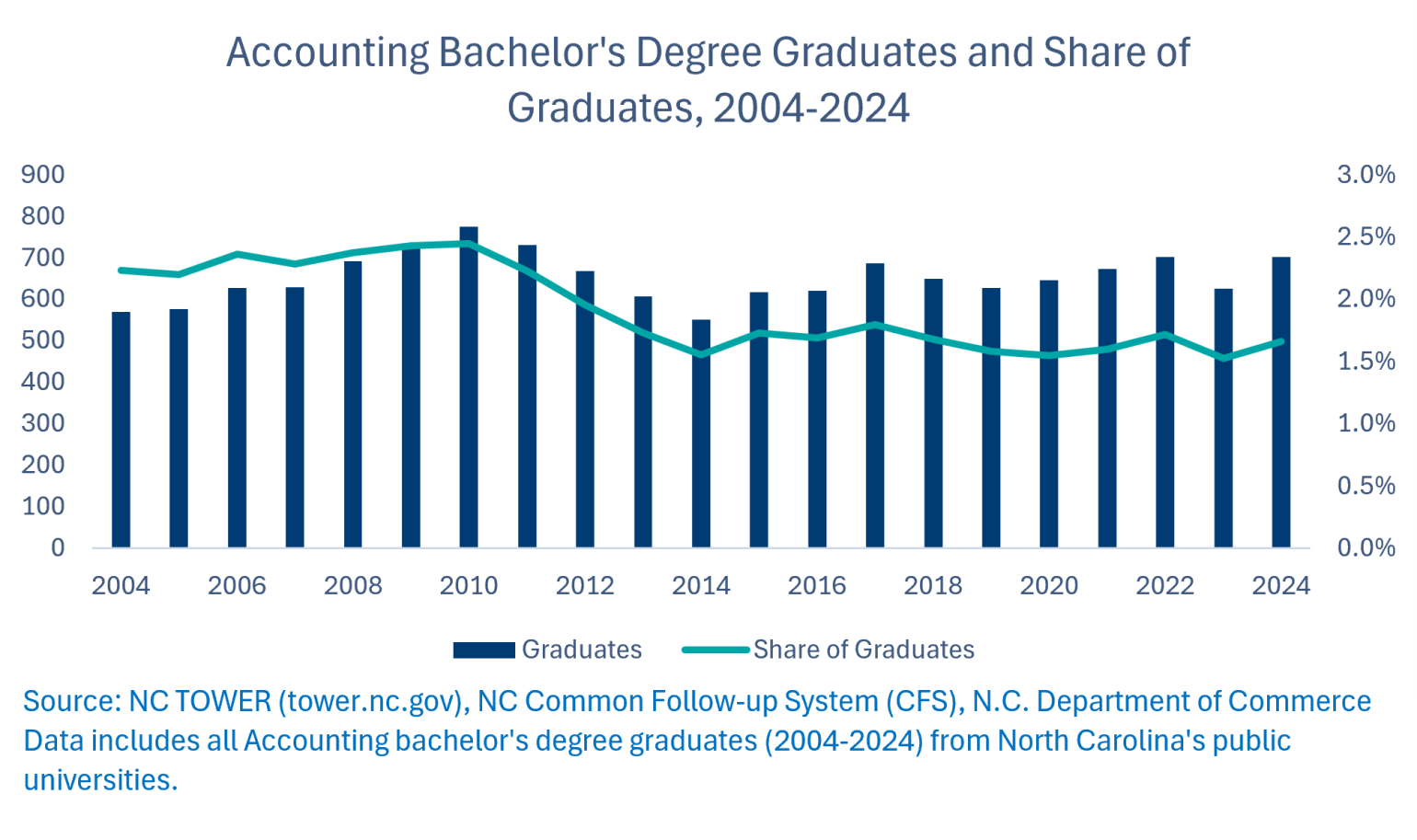
The number of students earning a bachelor’s degree in Accounting1 increased substantially between 2004 and 2010, peaking at 774 graduates. The number of graduates then declined each year from 2010 through 2014. Although the number of graduates rebounded after 2014, it never returned to its earlier peak. Consequently, Accounting’s share of all UNC System bachelor’s degree graduates declined from a high of 2.4 percent in 2006 and from 2008 through 2010 to 1.7 percent in 2024.
Figure 1
Accounting Bachelor’s Degree Graduates from UNC System Schools
Professional & Business Services Remained the Largest Employment Sector
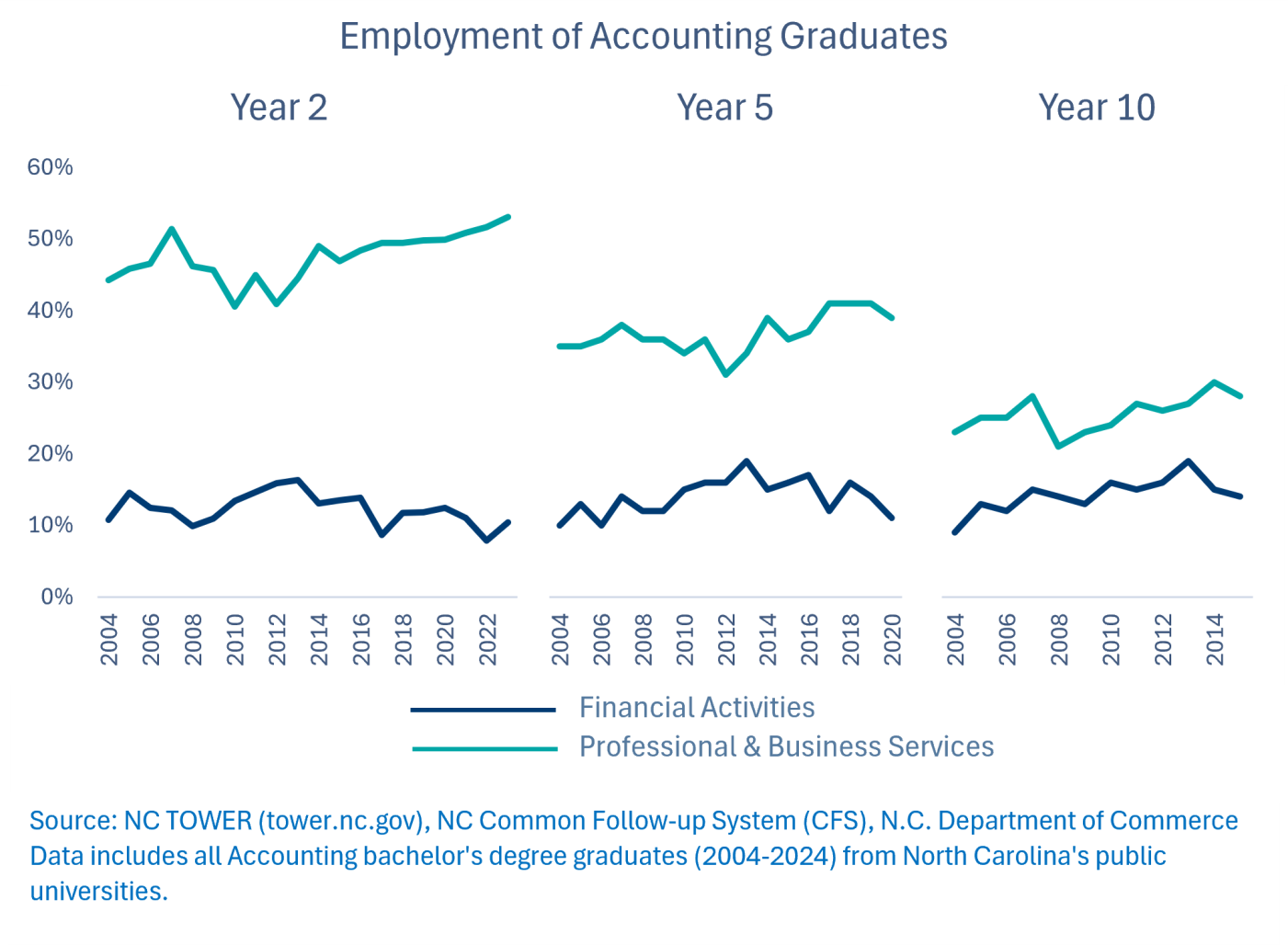
The Professional & Business Services sector (which includes the Professional, Scientific, and Technical Services, Management of Companies and Enterprises, and Administrative and Support and Waste Management and Remediation Services sectors) consistently employed the largest share of Accounting graduates, with approximately half of graduates employed in the sector in the second year after graduation. Financial Activities (including the Finance and Insurance and Real Estate and Rental and Leasing sectors) was the second-largest employment sector.
The share of early career graduates working in the Professional & Business Services sector increased among more recent cohorts, rising from 44 percent for the 2014 cohort to 53 percent for the 2023 cohort. Employment in the Financial Activities sector fluctuated between 8 and 16 percent across cohorts, with recent cohorts near 10 percent. This suggests that the Professional & Business Services sector has become an increasingly common early-career destination for recent Accounting graduates.
Employment patterns changed as graduates progressed through their careers. Within cohorts, the share of graduates employed in the Professional & Business Services sector generally declined with time since graduation, with roughly one in two graduates working in the sector in year 2, one in three in year 5, and, by year 10, one in five. Employment in the Financial Activities sector, by contrast, remained relatively stable over time.
Figure 2
Accounting Graduates’ Employment by Sector
Wages Grew with Experience
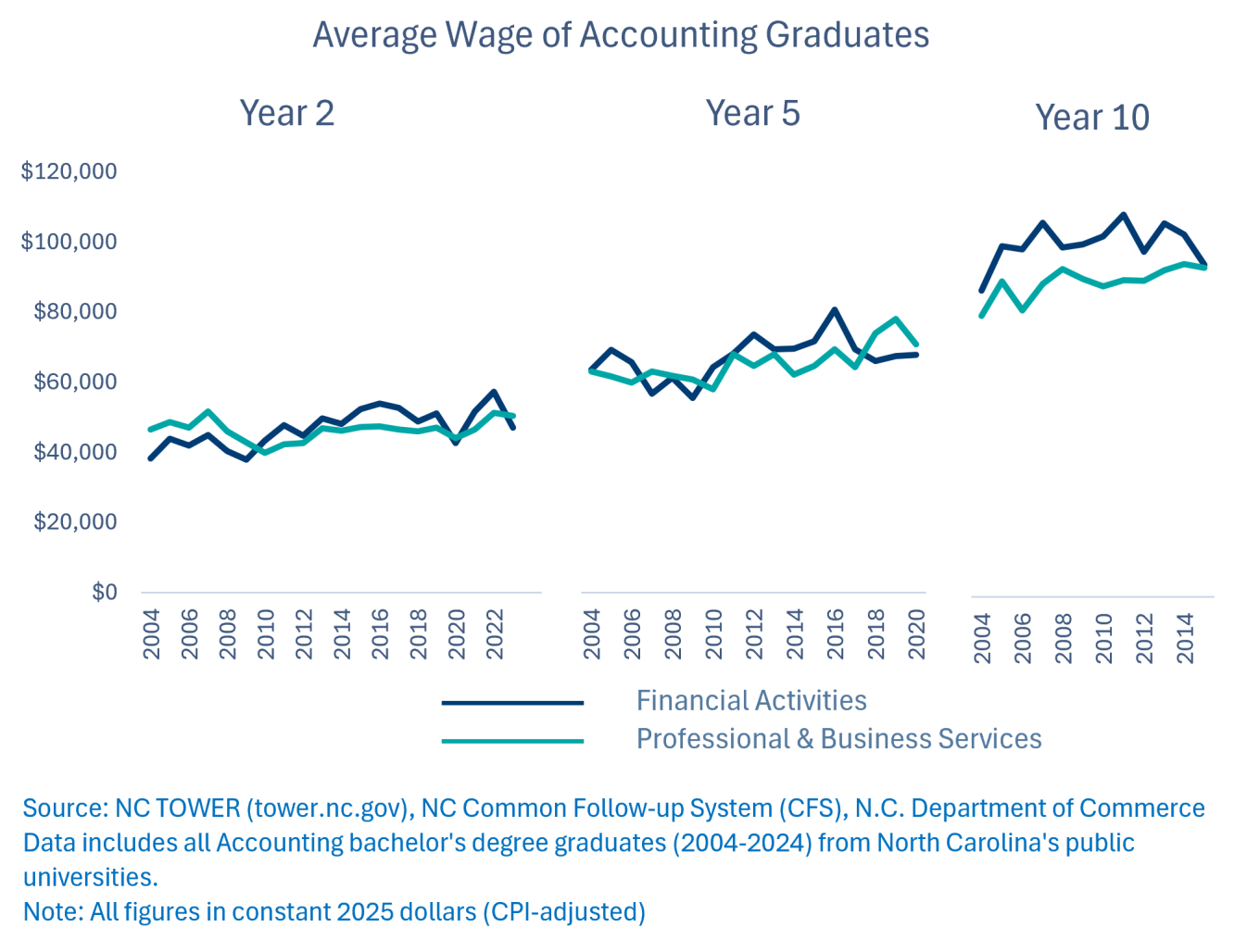
Average wages2 increased substantially with years since graduation in both the Professional & Business Services and Financial Activities sectors, but wage growth was stronger in Financial Activities.
Early career (year 2) wages in the two sectors were broadly comparable. Among cohorts graduating between 2004 and 2009, average wages in the Professional & Business Services sector were slightly higher than those in Financial Activities. For most cohorts graduating after 2009, however, the Financial Activities sector offered higher average wages, with exceptions for the 2020 and 2023 cohorts.
Five years after graduation, graduates in both sectors experienced significant earnings growth. Average wages in the Financial Activities sector peaked with the 2016 cohort before declining with the 2017 and 2018 cohorts.
Ten years after graduation, the wage advantage of the Financial Activities sector was more pronounced, although average wages declined for the 2015 cohort. Accounting graduates employed in the Financial Activities sector generally earned higher average wages than those employed in the Professional & Business Services sector, particularly later in their careers.
Figure 3
Average Wages of Accounting Graduates in the Financial Activities and Professional & Business Services Sectors
These findings suggest that Accounting offers strong career pathways in the Financial Activities and Professional & Business Services sectors. Professional & Business Services is an important early-career destination, while graduates’ employment patterns become more dispersed across sectors as they progress through their careers. The number of Accounting graduates from UNC System schools has not recovered to its 2010 peak. The declining share of Accounting graduates, alongside projected workforce demand, highlights the importance of understanding factors that may affect students’ interest in and access to Accounting programs. These trends may point to opportunities for employers to strengthen recruitment, work-based learning, and early-career development efforts to attract Accounting graduates.