

Using data from the Common Follow-up System (CFS), this article explores trends in College Transfer-Associate in Arts (AA) and College Transfer-Science (AS) degree completion from North Carolina community colleges between 2003 and 2023. These degrees allow students who subsequently enroll at UNC System schools to transfer with a junior status (for more information, see Transfer Resources). Students from the North Carolina Community College System make up almost 60 percent of all transfer students in the UNC System, underscoring the importance of these pathways. Analysis of these trends provides greater understanding of students’ postsecondary patterns over time.
The period from 2003 to 2023 saw tremendous growth in the number of students completing AA and AS degrees at North Carolina Community Colleges, rising from 2,339 to 14,365. These majors accounted for roughly one in five (22 percent) of all associate degree graduates in 2003, but by 2023, they represented almost half (47 percent). This shift highlights the growing importance of college transfer pathways within the NCCCS.
Completion of AS degrees increased substantially from 2003 to 2023, rising from 304 to 4,269, with larger gains in the mid-2010s. While AS degrees represented just three percent of associate’s degree completions in 2003, they made up 14 percent by 2023. Figure 1 presents the number of AA and AS graduates and their share of all associate’s degree completers.
Figure 1:
NCCCS College Transfer (AA and AS) Graduates, 2003-2023

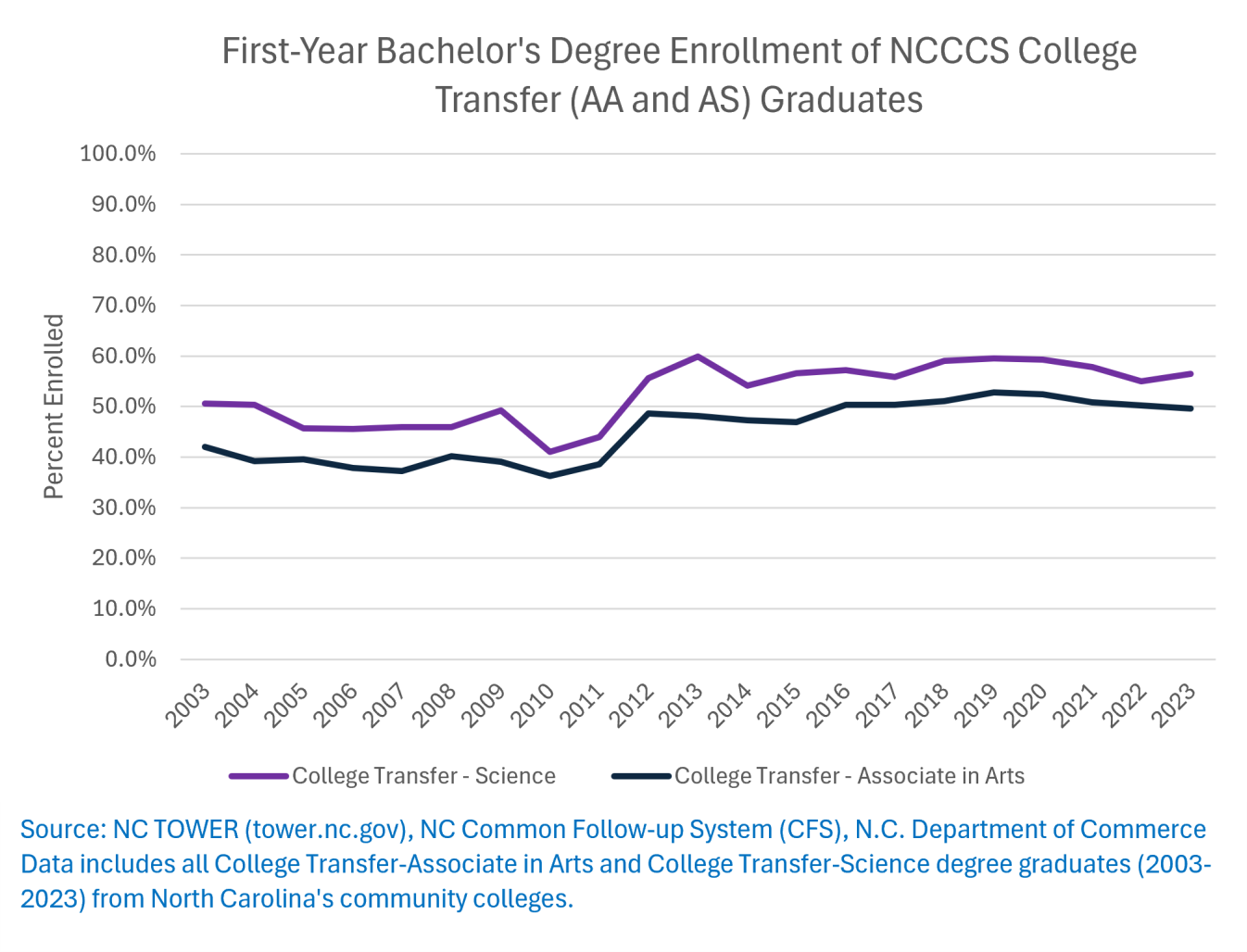
While the AA and AS degrees are designed to support transfer to a UNC System school, not all graduates pursue this pathway. About half of these graduates enrolled in a bachelor’s degree program during the first year after completing their associate degree. This finding is consistent with national research showing that 48 percent of transfer students earned a bachelor’s degree within six years of starting community college (see Tracking-Transfer-CC-REvised-2025.pdf for more information). Trends in first-year bachelor’s degree enrollment among graduates are presented in Figure 2.
Figure 2:
First-Year Bachelor’s Degree Enrollment of NCCCS College Transfer (AA and AS) Graduates, 2003-2023
Overall, the period from 2003 to 2023 reflects substantial growth in associate degree attainment across North Carlina community colleges, with especially strong gains in graduates with AA and AS degrees. Growth in AS completers also suggests increased student interest in STEM-related fields. These trends highlight the critical role of community college transfer pathways in broadening access to higher education, supporting academic upward mobility, and strengthening the pipeline into bachelor’s degree attainment and high demand fields.