

This article uses data from the Common Follow-up System (CFS) to explore trends in health-related degree completion across North Carolina’s public higher education systems. Specifically, it focuses on bachelor’s degree graduates in Health Professions and Related Programs and Registered Nursing majors at UNC System institutions and associate’s degree in Health Sciences and Nursing majors at North Carolina community colleges. Understanding these trends provides important insight into the state’s health talent pipeline and its capacity to meet growing demand - particularly as North Carolina’s aging population increases the need for healthcare services. The following sections highlight key trends in health-related degree completion across North Carolina’s universities and community colleges.
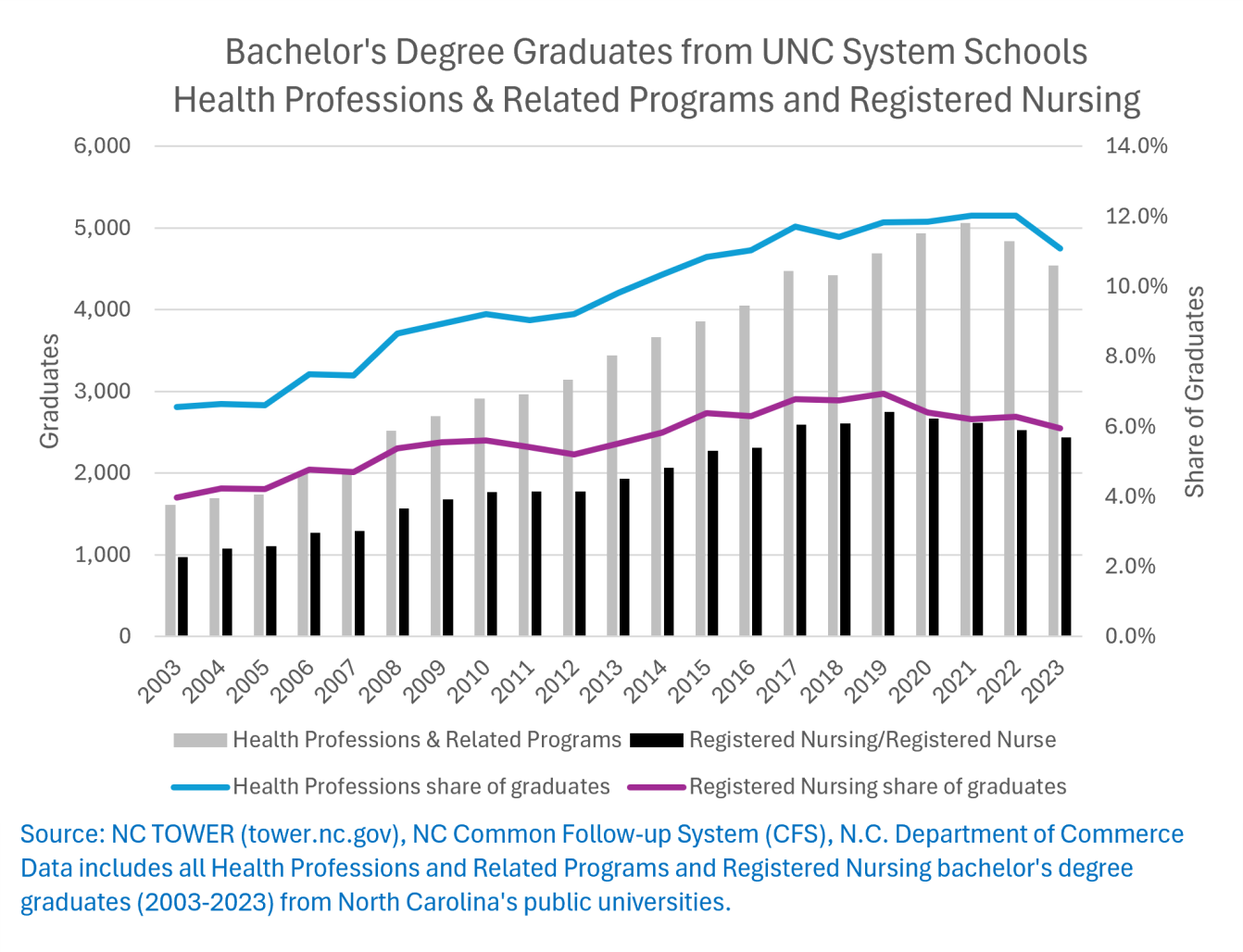
The number of students earning a bachelor’s degree in Health Professions and Related Programs more than tripled between 2003 and 2021, when it reached its peak of 5,062 graduates—12 percent of all UNC System bachelor’s graduates that year [Figure 1]. Health Professions and Related Programs is a broad category that comprises several health-related majors, including Public Health Education & Promotion, Health/Health Care Administration/Management, and Registered Nursing, to name a few. Registered Nursing is the largest of these majors, making up more than half of the field. The number of bachelor’s degree graduates in Registered Nursing rose from fewer than 1,000 in 2003 to 2,750 in 2019. After this peak, the number of graduates declined to roughly 2,400 by 2023, although the overall trajectory still reflects substantial growth over the twenty-year period.
Figure 1
UNC System Bachelor’s Degree Graduates in Health Professions and Related Programs and Registered Nursing, 2003-2023
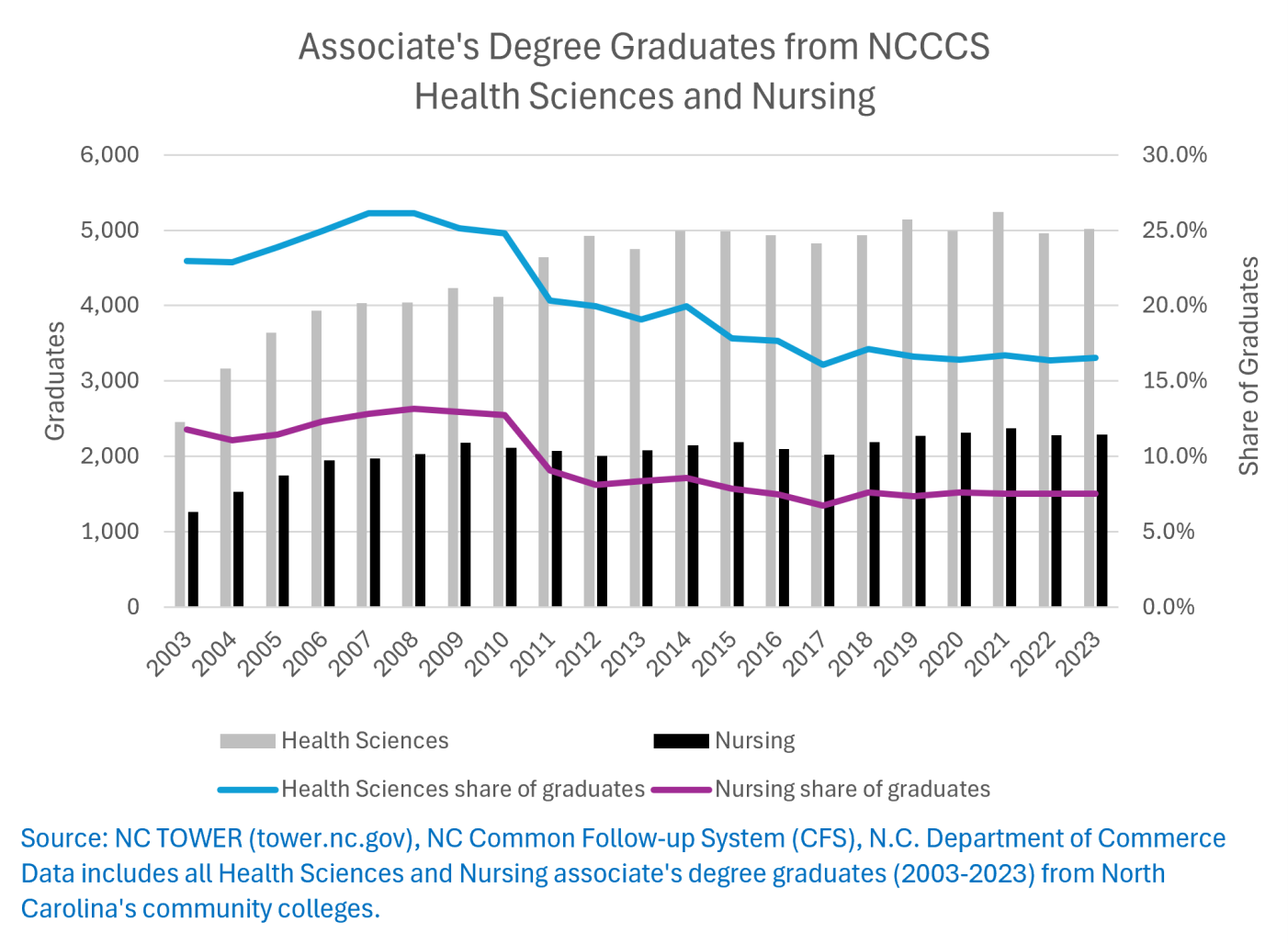
At North Carolina’s community colleges, the number of associate’s degree graduates in Health Sciences doubled between 2003 and 2023 [Figure 2]. Nursing made up the largest share of all Health Sciences majors, comprising between 40 and 50 percent of the field during the 2003 to 2023 period. The number of associate degree graduates in both Health Sciences and Nursing peaked in 2021, at 5,245 and 2,369 graduates, respectively. Although the number of overall Health Sciences graduates increased from 2003 to 2023, their share of all associate’s degree graduates decreased. This may be due to the significant growth in the number of College Transfer and General Education graduates (2,701 in 2003 and 16,430 in 2023) at North Carolina community colleges during this time.
Figure 2
North Carolina Community College Associate’s Degree Graduates in Health Sciences and Nursing, 2003-2023
The UNC System and the North Carolina Community College System play complementary roles in preparing North Carolina’s healthcare workforce. Across both systems, degree completion trends indicate that interest in health-related programs—particularly Nursing—expanded substantially throughout the 2003–2021 period, with the highest number of graduates coinciding with the early years of the COVID 19 pandemic, a period marked by heightened demand for healthcare workers.
While recent declines are evident among health-related programs degree recipients, the number of graduates remains elevated compared to the early 2000s, suggesting increased interest in this field over the past 20 years. Overall, these patterns underscore the continued importance of health-related programs in North Carolina’s education and workforce landscape. They also provide useful context for understanding the state’s health talent pipeline, as demographic changes continue to shape demand for healthcare services.