

The 2026 UNC System Workforce Alignment Report identified Psychology as a discipline where projected workforce demand is poised to exceed the future supply of graduates. Using data from the Common Follow-up System (CFS), this article explores two decades of trends in graduation patterns, graduate school enrollment, and employment outcomes for Psychology majors across UNC System institutions.
Psychology Degrees Show Signs of Renewed Growth
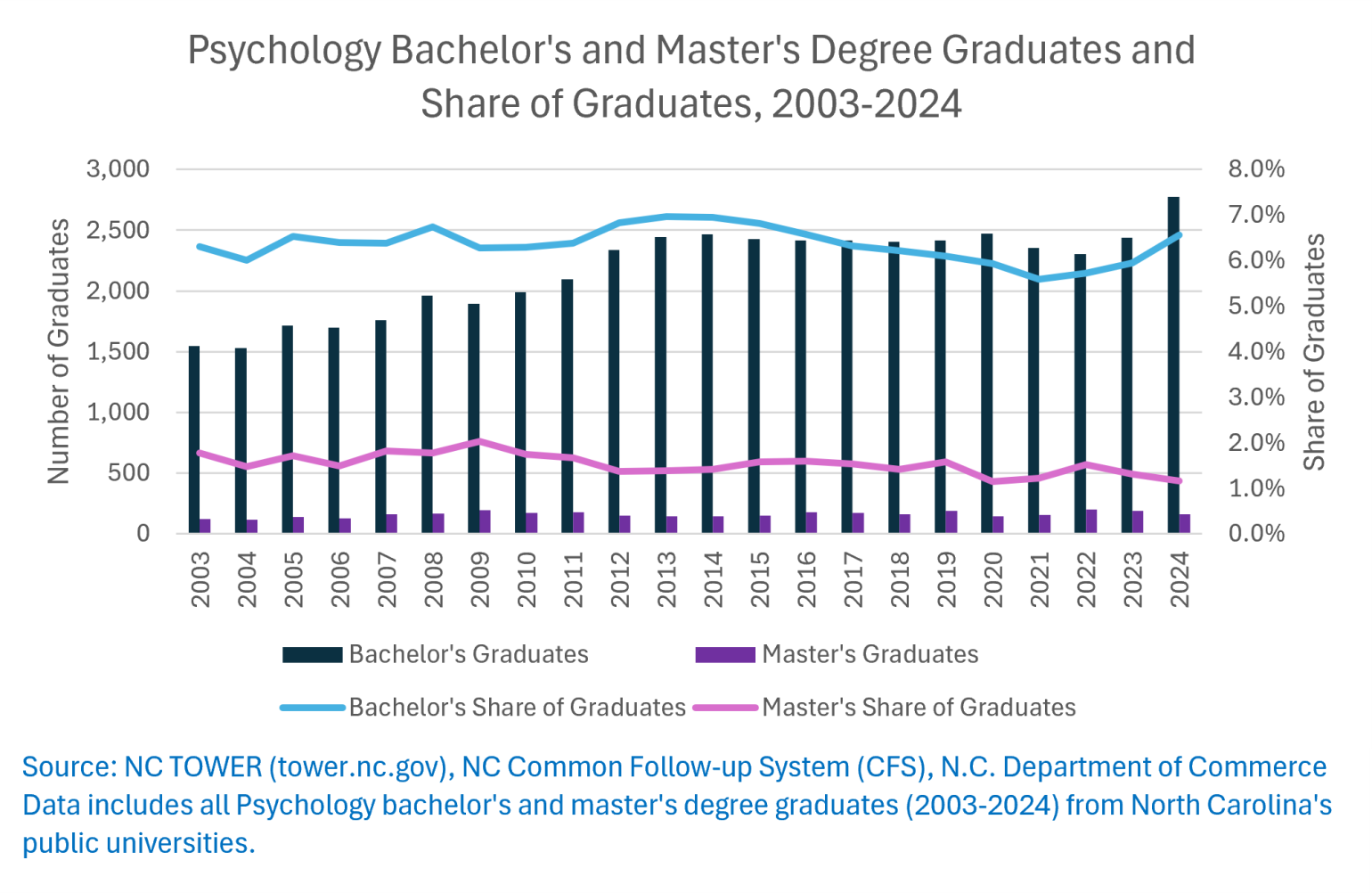
Psychology1 experienced a period of strong growth between 2003 and 2013, with bachelor’s degree recipients increasing from 1,548 to 2,441. Growth then leveled off for nearly a decade before rebounding to 2,776 in 2024. After declining to 5.6 percent in 2021, Psychology’s share of overall system-wide bachelor’s degree graduates climbed to 6.6 percent in 2024.
At the master’s level, the number of completions peaked in 2022 at 201, but Psychology’s share of all master’s degree graduates declined from 1.8 percent in 2003 to 1.2 percent in 2024. The trends in Psychology bachelor’s and master’s degree production are presented in Figure 1.
Figure 1
Psychology Bachelor’s and Master’s Degree Graduates from UNC System Schools
Graduate Education Remains a Common Pathway
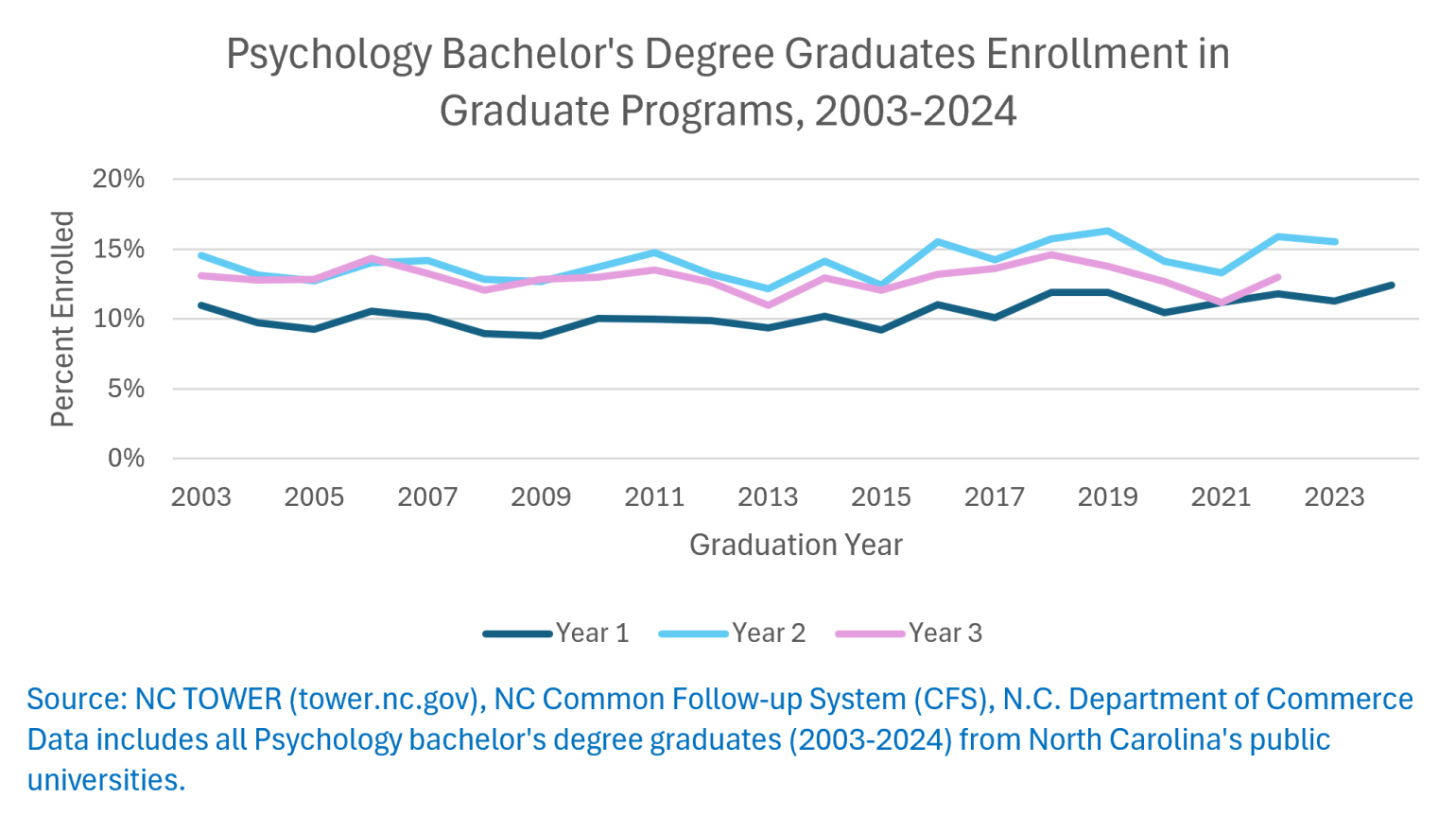
Graduate education remained a significant pathway for Psychology bachelor’s degree graduates. Approximately one in ten enrolled in a graduate program within one year of completing their degree, with a modest increase in enrollment during the second year. These trends indicate that Psychology continues to serve as a foundation for advanced education and specialized training.
Figure 2
Psychology Graduates’ Enrollment in Graduate Programs
Where Do Psychology Graduates Work?
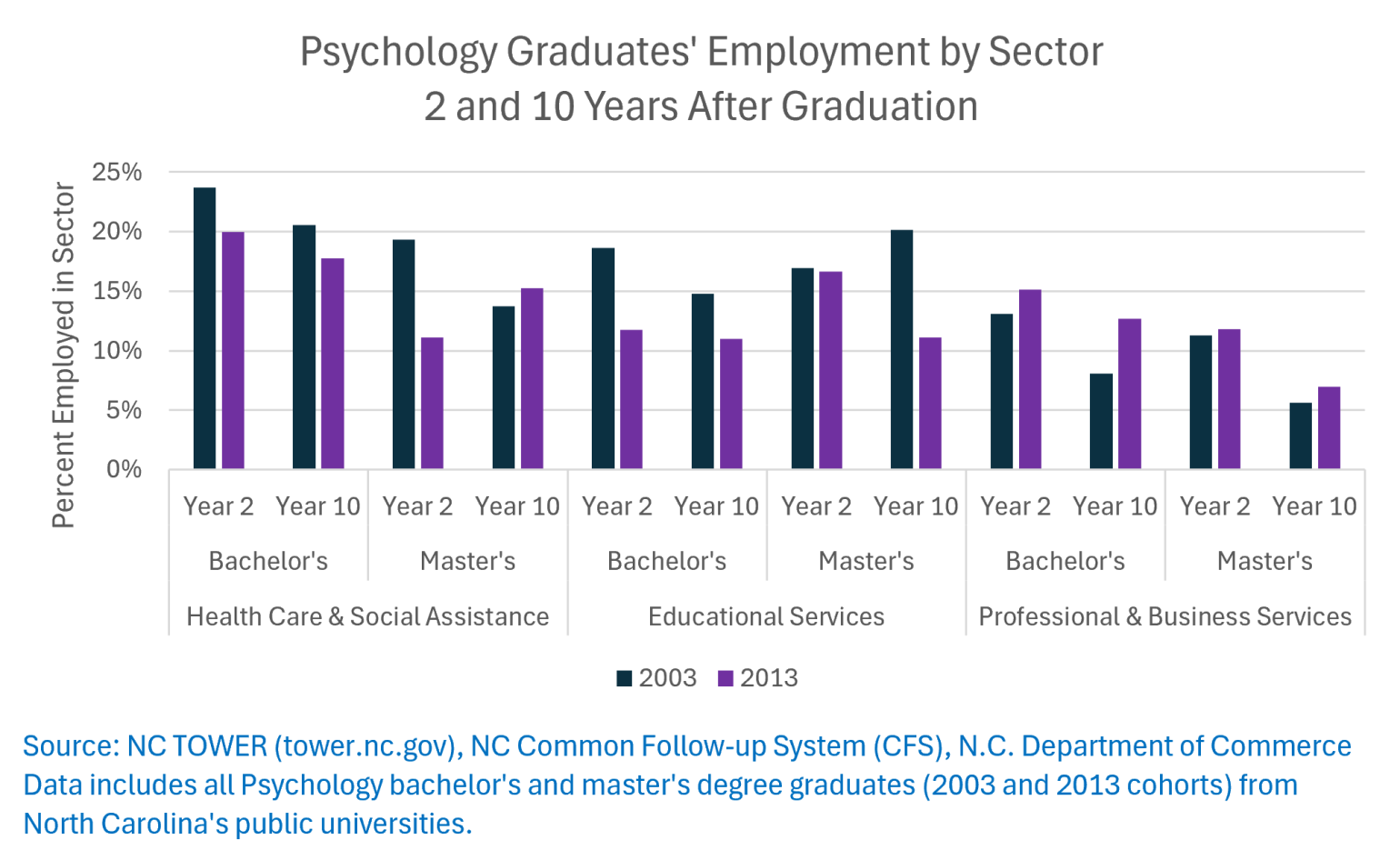
In the early years following graduation, Psychology graduates entered a broad array of industries. The sectors employing the largest share of recent graduates included Health Care & Social Assistance, Leisure & Hospitality, Educational Services, Professional & Business Services, and Retail Trade. As graduates gained experience, employment patterns shifted. Health Care & Social Assistance, Educational Services, and Professional & Business Services emerged as the dominant long-term employment sectors, while the share of working in Leisure and Hospitality and Retail Trade declined. Employment patterns in these sectors are presented in Figure 3.
Figure 3
Psychology Graduates’ Employment by Sector
Earnings Increase Significantly with Experience
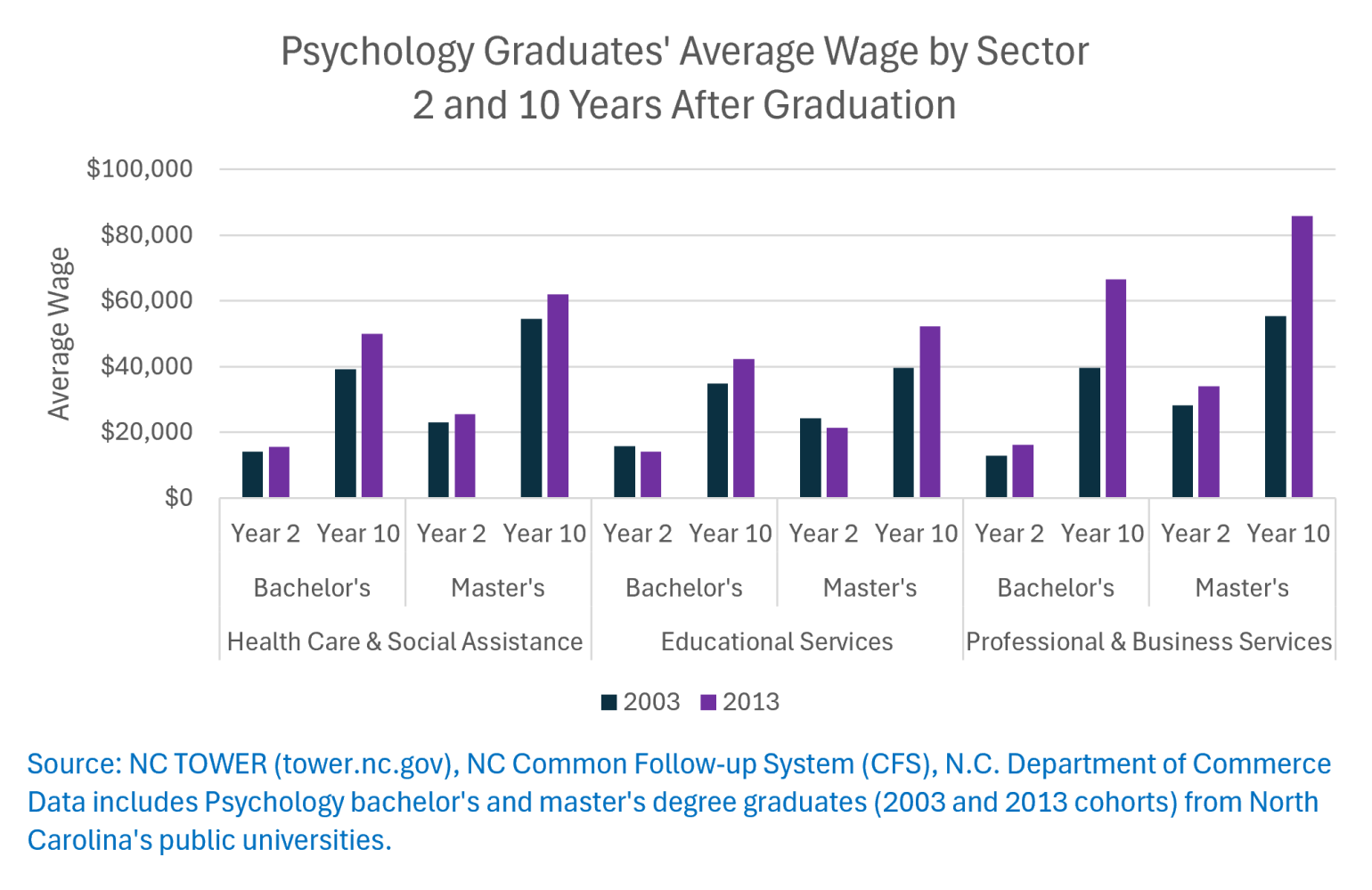
Across major employment sectors, average wages increased substantially with experience. Bachelor’s degree graduates nearly tripled their earnings between years two and ten after graduation, while master’s degree recipients saw earnings roughly double over the same period.
Master’s degree graduates earned nearly twice as much as bachelor’s graduates in year two; however, the wage gap narrowed by year ten. Considering the proportion of bachelor’s graduates who enrolled in graduate programs, it is reasonable to assume that a significant number earned an advanced degree during this time. Figure 4 highlights average wages by sector for selected cohorts.
Figure 4
Average Wages of Psychology Graduates, Health Care & Social Assistance, Professional & Business Services, and Educational Services Sectors
What These Trends Mean for North Carolina
These findings point to a leveling off in Psychology graduates before a jump in 2024—an important consideration given projected workforce demand. While the Health Care & Social Assistance and Educational Services sectors remained the largest long-term employers of Psychology graduates, the Professional & Business Services sector offered higher average wages, particularly after graduates gained experience. These trends provide valuable insight into program-to-workforce alignment and highlight Psychology’s contribution to North Carolina’s workforce in human services, education, and professional services sectors.
- 1
Includes CIP codes with program code 42