

February is Career and Technical Education (CTE) Month, a time to recognize the programs across North Carolina that prepare high school students for college and career success. With a focus on hands-on training and career exploration, CTE equips students with valuable technical skills while introducing them to career fields like Health Science, Manufacturing, Information Technology, and more.
Thanks to NC TOWER (North Carolina’s Tool for Workforce and Education Reporting), we can follow CTE students beyond graduation to see how these experiences translate into real workforce outcomes. The early results are encouraging. Among CTE concentrators1 from the Class of 2023, 77% found jobs2 in North Carolina within one year of graduating, and 68% enrolled in a community college or university during that same period.
But let’s look beyond the first year after high school. What do labor market outcomes look like ten years later? And do these outcomes differ depending on what CTE career cluster students chose?
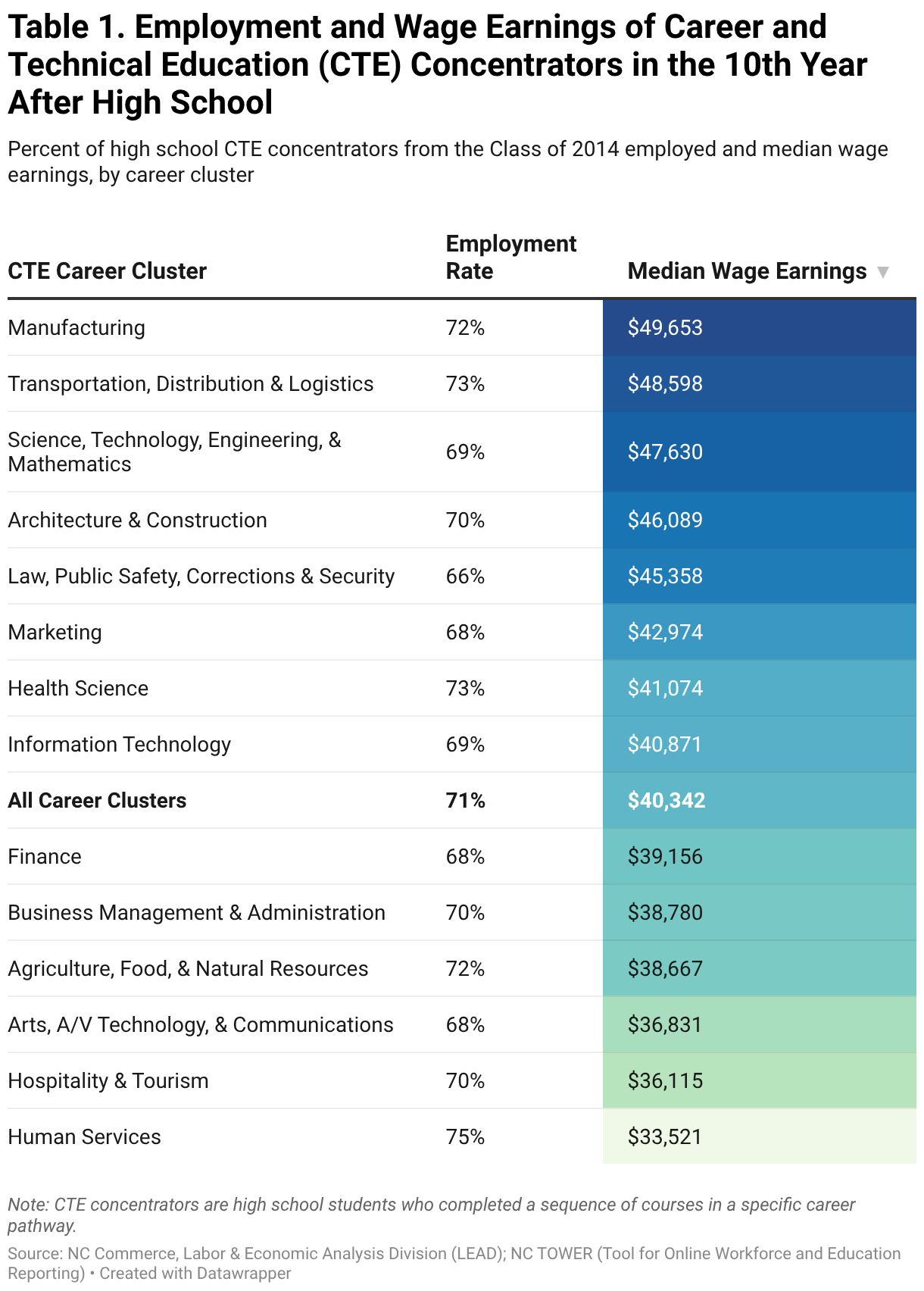
To find out, we tracked 32,000 CTE concentrators from the Class of 2014 to see where they landed a decade later. In 2024, 71% were employed, with median annual earnings of $40,342. Breaking out the outcomes by CTE career cluster reveals some interesting differences [Table 1]:
- Manufacturing CTE concentrators had the highest median wage earnings ten years later, at $49,653, followed closely by Transportation, Distribution, & Logistics ($48,598) and Science, Technology, Engineering & Mathematics ($47,630).
- Employment rates were highest among CTE concentrators in Human Services (75%); Health Science (73%); and Transportation, Distribution, & Logistics (73%).
- Among Agriculture, Food, & Natural Resources CTE concentrators, 72% were employed ten years later, with median wage earnings of $38,667.
Are you curious what these numbers look like for your area? Head over to tower.nc.gov and explore the data for yourself. And if you’re interested in learning how CTE impacts students with disabilities, check out this previous LEAD study.
- 1
A CTE concentrator is a student who has successfully completed a Concentrator course in an approved Career Pathway while enrolled in high school.
- 2
Employment rates reflect only jobs covered by North Carolina’s Unemployment Insurance (UI) system and do not include self-employment, out-of-state employment, military service, or informal work.