

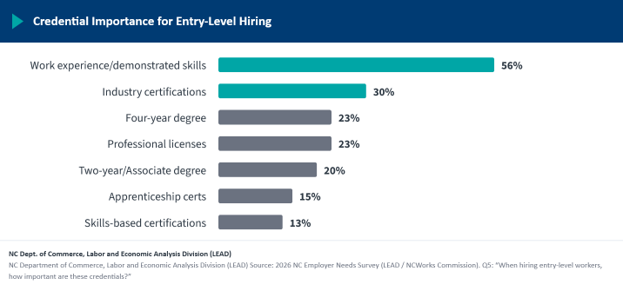
In addition to questions around hiring difficulties and barriers for applicants, the 2026 Employer Needs Survey asks employers that attempted to hire for entry-level positions to rate the importance of various credentials. Work experience and demonstrated skills topped the list in every sector: 56% of employers overall rated them important or very important. As for formal credentials, Health Care as well as Education and Child Care employers valued them more often than overall employers, while Manufacturing employers tended to value them less often.
Starting with overall employers, the data show that more than half of those that attempted entry-level hiring rated work experience and demonstrated skills as important or very important for entry-level hires. Experience is almost double the next credential. All others received 13-30%.
The survey was also carried out for three different sectors: Health Care, Education and Child Care, and Manufacturing. Health Care follows the same pattern as overall employers, with an even higher share of respondents assigning importance to work experience and demonstrated skills.
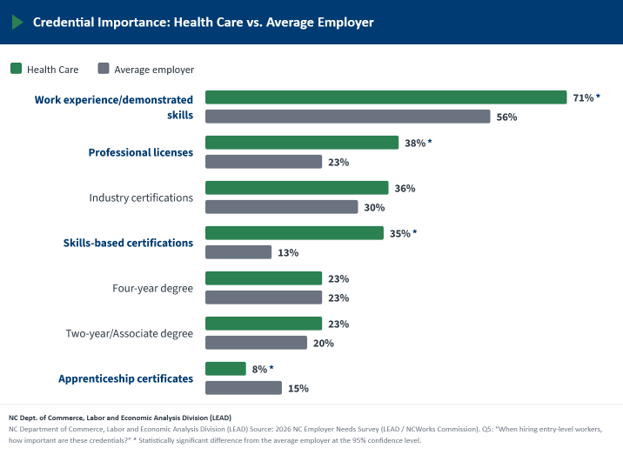
While not every difference is statistically significant relative to the overall share, Health Care employers found credentials to be important more frequently than overall employers, with two exceptions. Apprenticeship certificates were less frequently important for health care employers. The other exception was a four year degree, which had the same frequency of importance between the two groups. This likely reflects the highly regulated, highly specialized nature of health care jobs. Work experiences and licenses serve as clear signals of applicants’ capacity to meet the demands of that work, along with industry certifications and skills-based certifications.
For Education and Child Care employers, more than four in every five employers marked work experience and demonstrated skills as important, greatly exceeding overall employers.
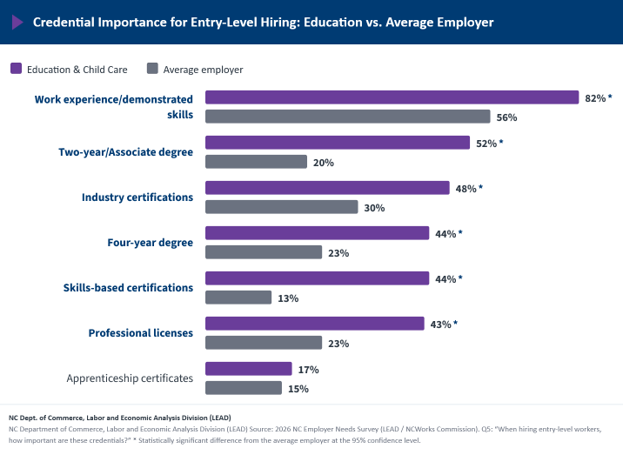
Education and Child Care employers identified every formal credential as important at higher rates than overall employers, reaching between 43% and 52% in every case except apprenticeship certificates. Much like Health Care, the differences between Education and Child Care employers and businesses in general are likely due to the regulated, specialized nature of the industry.
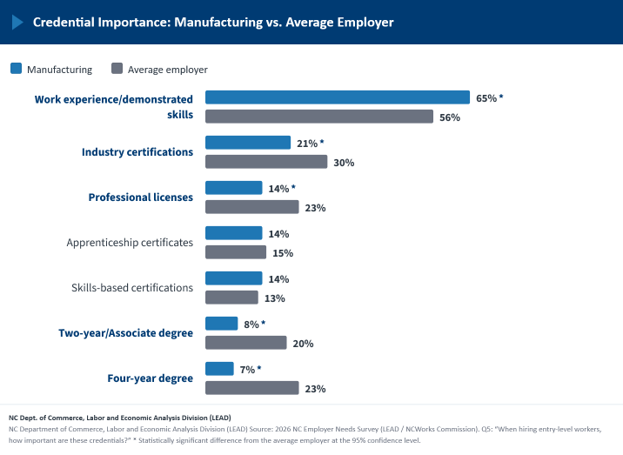
Continuing the trend among sectors, Manufacturing employers rated work experience and demonstrated skills as more important than any formal credential. Manufacturing was the only sector where fewer than 10% of employers rated two-year and four-year degrees as important.
One possible explanation for the low importance placed on two-year and four-year degrees is that manufacturing work may benefit from hands-on experience and on-the-job learning than classroom instruction. However, Manufacturing employers were also less likely than overall employers to rate industry certifications and professional licenses as important. This could be due to the survey’s focus on entry-level hiring as these credentials may be best utilized by workers with existing job experience to bolster their skill sets.
Work-based learning gives jobseekers a way to build the experience employers want
As the results emphasize work experience and demonstrated skills, a familiar labor market paradox comes to mind: employers often want candidates with a proven record, but candidates need a job to build that record. One way to address this challenge is to encourage employers’ participation in work-based learning. Programs such as pre-apprenticeships and registered apprenticeships can not only provide participants with experience, skills, and proficiencies, but introduce employers to potential applicants and reduce recruitment costs. These programs can help create better matches between employers and jobseekers, potentially leading to better pay, benefits, and careers for workers, improved productivity for employers, and broader economic gains for the state.
For more information on the Employer Needs Survey, you can read either the full report or the data story.