
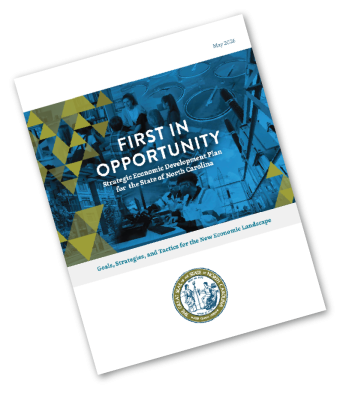
North Carolina’s “First in Opportunity” Strategic Economic Development Plan is the state’s comprehensive four-year roadmap for strengthening economic competitiveness, expanding opportunity, and supporting long-term growth across North Carolina. Building on the success of the state’s “First in Talent” strategy, the plan takes a broader approach to economic development by recognizing that resilient infrastructure, workforce readiness, innovation, housing, and strong communities are all essential to sustained economic success.
Developed through extensive stakeholder engagement and collaboration with leaders from business, education, workforce development, local government, and nonprofit organizations, the plan outlines strategies to help ensure North Carolina’s growth is sustainable, resilient, and broadly shared. The framework is organized around four strategic goals: modernizing and fortifying infrastructure, accelerating economic competitiveness and innovation, enhancing community well-being, and building a resilient, future-ready workforce.
Read the First in Opportunity Plan
First in Opportunity Strategic Economic Development Plan
The “First in Opportunity” Strategic Economic Development Plan is North Carolina’s comprehensive four-year roadmap for strengthening economic competitiveness, expanding opportunity, and supporting long-term growth across the state. Building on the success of the state’s “First in Talent” strategy, this plan takes a broader approach to economic development by recognizing that workforce readiness, infrastructure, innovation, housing, childcare, and strong communities are all connected and essential to sustained economic success.
At its core, the plan is focused on ensuring North Carolina’s growth is sustainable, resilient, and broadly shared. North Carolina remains one of the nation’s top-performing states economically, but continued success will require intentional investments that help every region of the state compete and grow. The plan is designed to help communities strengthen their local economies, attract investment, support businesses, prepare workers for future industries, and improve quality of life for North Carolinians.
The framework is organized around four strategic goals:
- Modernizing and fortifying infrastructure to strengthen resilience, improve connectivity, and support long-term growth.
- Accelerating economic competitiveness by strengthening innovation ecosystems and supporting industries that position North Carolina to compete globally.
- Enhancing community well-being by expanding access to housing, childcare, and healthcare so that more North Carolinians can fully participate in the economy.
- Building a resilient, future-ready workforce through stronger statewide coordination across education, workforce development, and economic development systems.
North Carolina’s Comprehensive Strategic Economic Development Plan is updated every four years in accordance with state law and serves as the state’s long-term framework for economic development priorities and coordination. The “First in Opportunity” Plan builds upon the success of the state’s previous “First in Talent” strategy while responding to the rapidly changing economic environment facing North Carolina today. The state is experiencing continued population growth, workforce pressures, infrastructure demands, technological transformation, and recovery challenges following severe weather events like Hurricane Helene. This updated plan recognizes that maintaining North Carolina’s competitiveness will require a more coordinated, forward-looking approach that strengthens infrastructure, supports innovation, invests in workforce readiness, and helps ensure economic opportunity reaches communities across the state.
The plan was shaped through an extensive, data-driven, and community-centered planning process led by the North Carolina Department of Commerce in partnership with Governor Josh Stein and stakeholders across North Carolina. The state convened a Strategic Economic Development Plan Steering Committee made up of leaders from business, education, workforce development, local government, and nonprofit organizations to help guide the process.
In addition, the Department partnered with the UNC School of Government’s ncIMPACT Initiative to conduct statewide stakeholder engagement, including nine public listening sessions across North Carolina’s Prosperity Zones and a statewide webinar. Approximately 650 participants representing 91 counties helped identify priorities including workforce readiness, infrastructure, housing, childcare, innovation, and quality of life.
The Department also partnered with KPMG during the research and plan development phase to analyze stakeholder feedback, benchmark national best practices, and help organize the plan’s long-term strategies and implementation framework. That work helped ensure the plan reflects both community input and broader economic trends shaping North Carolina’s future competitiveness.
The plan is designed to create long-term economic opportunity and strengthen quality of life across North Carolina. That includes helping communities compete for new jobs and investment, supporting workforce development and innovation, strengthening infrastructure and resilience, and ensuring residents have access to the foundational supports, including housing and childcare, that allow more people to participate fully in the economy.
The plan recognizes that rural communities are critical to North Carolina’s economic future. It emphasizes strategies focused on infrastructure, workforce development, downtown revitalization, innovation, tourism, site readiness, and public-private partnerships that help communities build on their unique strengths and create long-term economic momentum. Communities like Wilson demonstrate how coordinated investments can strengthen local economies and expand opportunity.
Throughout the statewide listening sessions and stakeholder engagement process, communities consistently emphasized that economic growth depends on more than job creation alone. Participants across North Carolina identified housing affordability, access to childcare and healthcare, workforce access, infrastructure capacity, and overall quality of life as critical factors influencing whether communities can attract businesses, support workers, and sustain long-term growth.
The “First in Opportunity” Plan recognizes these foundational supports as essential economic infrastructure that helps people participate fully in the workforce and helps communities remain competitive. Through its community well-being and workforce strategies, the plan encourages stronger coordination across economic development, housing, workforce, infrastructure, and community partners to help address barriers that impact economic opportunity and long-term resilience statewide.
The “First in Opportunity” Plan builds upon the success of the state’s 2021 “First in Talent” strategy while expanding the focus to address the broader conditions that support economic growth and competitiveness. The plan recognizes that attracting jobs and investment also requires strong infrastructure, resilient communities, workforce readiness, innovation, and quality-of-life investments that help businesses and residents succeed.
Successfully implementing the “First in Opportunity” Plan will require continued collaboration across state agencies, local governments, businesses, educational institutions, workforce organizations, nonprofit partners, and community leaders. The plan is designed to serve as a shared framework that helps align efforts around common goals tied to economic competitiveness, infrastructure, workforce readiness, innovation, and community well-being.
Communities and partners can help advance the plan by identifying local priorities, strengthening regional partnerships, supporting workforce and infrastructure investments, encouraging innovation and entrepreneurship, and helping ensure more North Carolinians have access to the foundational supports needed to participate fully in the economy. The plan recognizes that long-term economic success depends on coordinated action and strong partnerships across every region of the state.
Plan Development
A process to develop the state's next strategic plan for economic development is underway. We anticipate the plan will be finalized and published in the spring of 2026, following a comprehensive process to engage and hear from a variety of partners and stakeholders from across the state.
Under state law, North Carolina develops and follows a Comprehensive Strategic Economic Development Plan. The law mandates the creation of a four-year plan that sets a unified vision for statewide economic development.
The plan aligns partners and policies across government, industry, education, and communities to ensure that all North Carolinians — regardless of geography or background — have the opportunity to succeed.
Chaired by North Carolina Commerce Secretary Lee Lilley, a Comprehensive Strategic Economic Development Plan Steering Committee has been formed, and includes leaders from business, education, workforce development, local government, and nonprofit organizations. Members will advise on key themes, emerging priorities, and effective strategies to drive economic advancement across diverse communities and sectors. The Steering Committee is charged with:
- Supporting outreach and engagement efforts during a series of regional listening sessions.
- Reviewing data and stakeholder input to help identify key themes and focus areas.
- Providing expert guidance and diverse perspectives on policy and program recommendations.
Review the list of Steering Committee Members at this link.
Earlier, we conducted a series of listening session across the state, to ensure broad engagement and community input for the planning process. These sessions elevated local voices, identified regional priorities, and will help ensure the strategic plan reflects the diverse needs and aspirations of communities across North Carolina.
Listening sessions were held at these locations:
- Wednesday, August 27 | 10:00am - 11:45am | Durham (Central Pines Regional Council)
- Thursday, August 28 | 3:00pm - 4:45pm | Kernersville (Piedmont Triad Regional Council)
- Monday, September 8 | 3:00pm - 4:45pm | Charlotte (Centralina Regional Council)
- Friday, September 12 | 10:30am - 12:15pm | Pembroke (Lumber River Council of Governments)
- Thursday, September 18 | 3:00pm - 4:45pm | Sylva (Southwestern Community College)
- Friday, September 19 | 10:00am - 11:45am | Lenoir (Caldwell County Resource Center)
- Tuesday, September 23 | 10:00am - 11:45am | Edenton (Historic 1767 Chowan County Courthouse)
- Wednesday, September 24 | 10:00am - 11:45am | Jacksonville (Coastal Carolina Community College)
- Tuesday, September 30 | 10:00am - 11:00am | Virtual
This page was last modified on 05/21/2026