
Star Jobs Methodology

North Carolina Star Jobs Methodology
A Guide for Education and Workforce Professionals
What Are Star Jobs?
Star Jobs is a rating methodology that evaluates occupations across North Carolina based on three key factors – wages, projected growth, and demand – and assigns each occupation to a rating from 1 to 5 stars.
Occupations are evaluated within each of 17 regions (North Carolina statewide plus 16 sub-state prosperity zones) using 10-year employment projections, wages, and education requirements. The same occupation may receive different star ratings across regions based on local economic conditions.
Occupations with very few projected openings in a region or with insufficient wage data are excluded from scoring and are not assigned a rating. These are typically very small or specialized occupations.
What Do the Stars Mean?
| Rating | What It Means |
|---|---|
| Unrated | Not rated. This occupation cannot be evaluated reliably. The absence of a rating does not indicate that the occupation lacks value, only that local data is insufficient to assess it. |
| 1 Star | Limited career potential. Typically below median wage occupations with limited advancement opportunity. Most require little to no formal education or training. |
| 2 Stars | Building block career. Typically below median wage occupations that may require some level of education or skill that could be used to build upon. |
| 3 Stars | Solid career. Near or above median wage occupations with mixed growth, ranging from strong growth to slight declines. |
| 4 Stars | Strong career. Above median wage occupations with stable or positive employment growth. |
| 5 Stars | Excellent career. Top earning occupations in the region with stable to strong employment growth. |
How Are Stars Calculated?
Star ratings are derived through a multi-step process that includes eligibility filtering, factor-based scoring, and rule-based adjustments.
Step 1: Eligibility Filter
Before scoring, occupations with very few annual projected openings are excluded and assigned 0 stars (unrated). The thresholds vary by region size:
- NC Statewide: Exclude if fewer than 100 projected openings (under 10 per year)
- Raleigh-Durham and Charlotte: Exclude if fewer than 20 projected openings
- All other regions: Exclude if fewer than 10 projected openings
Remaining occupations earn points based on three factors:
Step 2: Wage Score (1-10 points)
The occupation's median annual wage is compared to all other rated occupations within the same region. Occupations are ranked into ten equal groups (deciles), from the lowest paying 10% (1 point) to the highest paying 10% (10 points). This ensures that wages are measured relative to the regional labor market.
Step 3: Growth Score (0-2 points)
The occupation's projected average annual growth rate is compared to a statewide benchmark.
- 0 points - Occupation is projected to decline
- 1 point - Growing, but slower than the state average
- 2 points - Growing at or faster than the state average
Step 4: Demand Score (0-1 point)
An occupation earns 1 bonus point if it meets BOTH conditions:
- a) Its wage is at or above the regional median wage (wage gate)
- b) Its average annual openings meet or exceed the region's median average annual openings per occupation
This prevents low-wage, high-turnover occupations from being rewarded simply for having many openings.
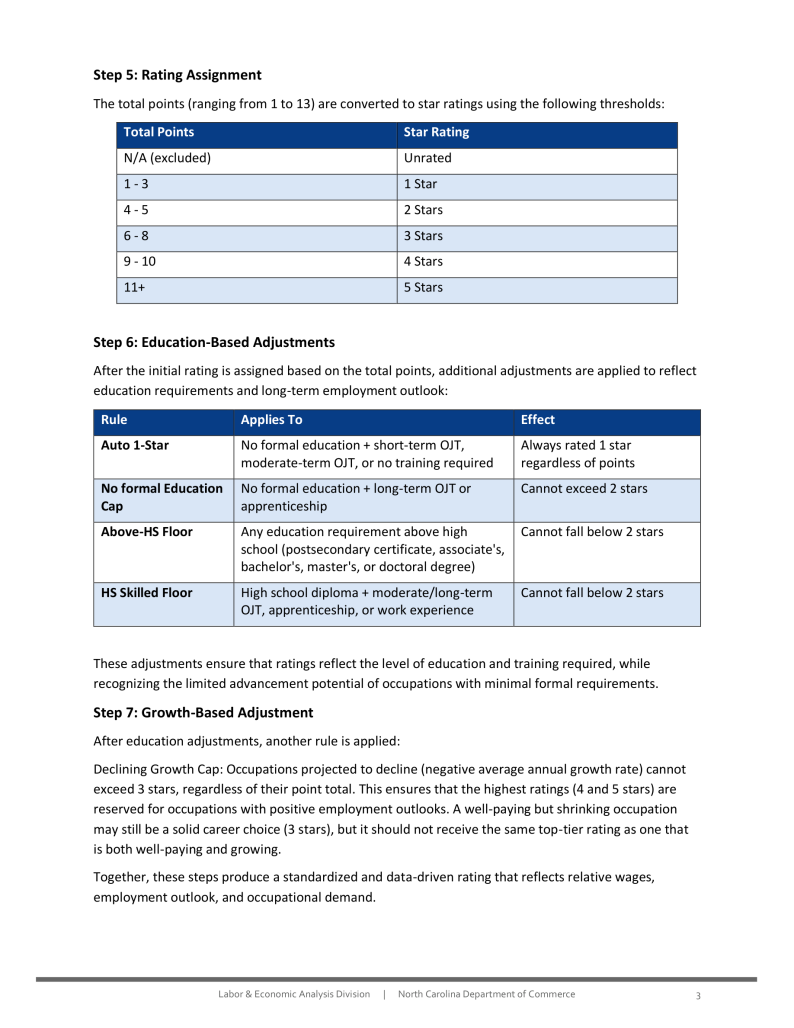
Step 5: Rating Assignment
The total points (ranging from 1 to 13) are converted to star ratings using the following thresholds:
| Total Points | Star Rating |
|---|---|
| N/A (excluded) | Unrated |
| 1 - 3 | 1 Star |
| 4 - 5 | 2 Stars |
| 6 - 8 | 3 Stars |
| 9 - 10 | 4 Stars |
| 11+ | 5 Stars |
Step 6: Education-Based Adjustments
After the initial rating is assigned based on the total points, additional adjustments are applied to reflect education requirements and long-term employment outlook:
| Rule | Applies To | Effect |
|---|---|---|
| Auto 1-Star | No formal education + short-term OJT, moderate-term OJT, or no training required | Always rated 1 star regardless of points |
| No formal Education Cap | No formal education + long-term OJT or apprenticeship | Cannot exceed 2 stars |
| Above-HS Floor | Any education requirement above high school (postsecondary certificate, associate's, bachelor's, master's, or doctoral degree) | Cannot fall below 2 stars |
| HS Skilled Floor | High school diploma + moderate/long-term OJT, apprenticeship, or work experience | Cannot fall below 2 stars |
These adjustments ensure that ratings reflect the level of education and training required, while recognizing the limited advancement potential of occupations with minimal formal requirements.
Step 7: Growth-Based Adjustment
After education adjustments, another rule is applied:
Declining Growth Cap: Occupations projected to decline (negative average annual growth rate) cannot exceed 3 stars, regardless of their point total. This ensures that the highest ratings (4 and 5 stars) are reserved for occupations with positive employment outlooks. A well-paying but shrinking occupation may still be a solid career choice (3 stars), but it should not receive the same top-tier rating as one that is both well-paying and growing.
Together, these steps produce a standardized and data-driven rating that reflects relative wages, employment outlook, and occupational demand.
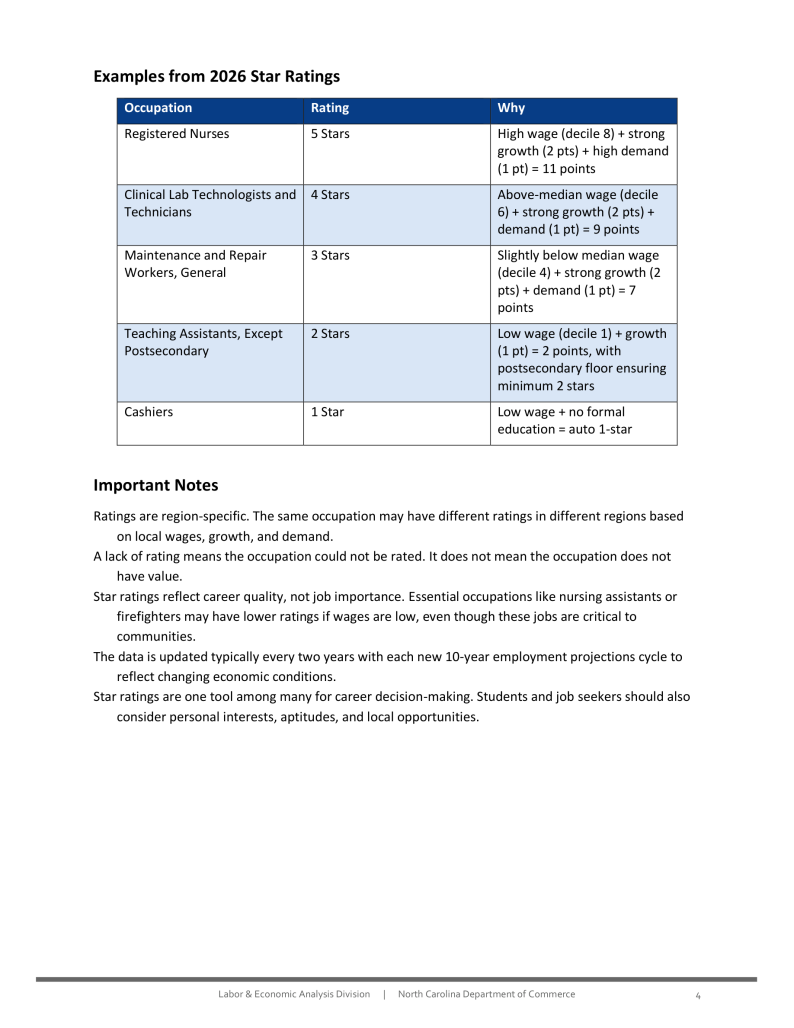
Examples from 2026 Star Ratings
| Occupation | Rating | Why |
|---|---|---|
| Registered Nurses | 5 Stars | High wage (decile 8) + strong growth (2 pts) + high demand (1 pt) = 11 points |
| Clinical Lab Technologists and Technicians | 4 Stars | Above-median wage (decile 6) + strong growth (2 pts) + demand (1 pt) = 9 points |
| Maintenance and Repair Workers, General | 3 Stars | Slightly below median wage (decile 4) + strong growth (2 pts) + demand (1 pt) = 7 points |
| Teaching Assistants, Except Postsecondary | 2 Stars | Low wage (decile 1) + growth (1 pt) = 2 points, with postsecondary floor ensuring minimum 2 stars |
| Cashiers | 1 Star | Low wage + no formal education = auto 1-star |
Important Notes
Ratings are region-specific. The same occupation may have different ratings in different regions based on local wages, growth, and demand.
A lack of rating means the occupation could not be rated. It does not mean the occupation does not have value.
Star ratings reflect career quality, not job importance. Essential occupations like nursing assistants or firefighters may have lower ratings if wages are low, even though these jobs are critical to communities.
The data is updated typically every two years with each new 10-year employment projections cycle to reflect changing economic conditions.
Star ratings are one tool among many for career decision-making. Students and job seekers should also consider personal interests, aptitudes, and local opportunities.