
North Carolina ARC 2026 Strategy Statement

North Carolina Appalachian Regional Commission Program 2026 Annual Strategy Statement

STATE OF NORTH CAROLINA
OFFICE OF THE GOVERNOR
JOSH STEIN
GOVERNOR
September 4, 2025
Mr. Brandon McBride
Executive Director
Appalachian Regional Commission
1666 Connecticut Avenue, N. W.
Suite 700
Washington, D. C. 20009-1068
Dear Mr. McBride,
I am pleased to submit North Carolina’s 2026 Strategy Statement. This document outlines our strategic priorities for investing Appalachian Regional Commission (ARC) funds to enhance economic opportunity and quality of life across North Carolina’s Appalachian region. The submission aligns with the requirements of the Appalachian Regional Development Act of 1965, as amended, and Section 5 of the ARC Code.
The 2026 Strategy Statement focuses resources on the areas of greatest need within our ARC counties. In particular, the program will support communities recovering from the devastating impacts of Hurricane Helene. The State will utilize ARC funding to help build a stronger, more resilient future.
If you have any questions regarding this submission, please contact Jim McCleskey, my ARC alternate, or Olivia Collier, my ARC program manager.
Sincerely,
Josh Stein
Governor
cc: Jim McCleskey
Olivia Collier
Enclosures
North Carolina ARC 2026 Strategy Statement
In accordance with Section 5.4 of the Appalachian Regional Commission (ARC) Code, this document serves as North Carolina’s ARC Annual Strategy Statement for Fiscal Year 2026 (October 1, 2025 – September 30, 2026)1. The purpose of the Strategy Statement is to describe the State's program for achieving the goals and objectives contained in the North Carolina Appalachian Regional Commission (NC ARC) Development Plan. Implementation of the Strategy will continue to meet the diverse and shifting needs of ARC counties in North Carolina by targeting resources to assist in meeting those needs. The 2026 Strategy Statement:
- Discusses the economic challenges and opportunities, as well as new developments and resources, that are impacting the state’s Appalachian counties;
- Provides an overview of targeted investment priorities for the program year;
- Sets forth state operating program policies; and,
- Describes the methods used to review proposals to ensure an equitable allocation of state contributions for projects in its Appalachian area.
Governor Josh Stein is North Carolina’s member of the Commission; Jim McCleskey, the Director of the Governor’s Washington, D.C. Office, serves as his Alternate. The North Carolina Department of Commerce is responsible for the administration of the NC ARC Program.
Governor Josh Stein is committed to building a stronger, more inclusive North Carolina— “NC Strong”—where every resident, regardless of their background or zip code, has access to economic opportunity. He believes that where you come from should never limit how far you can go. That’s the promise of North Carolina: ensuring every North Carolinian has a fair shot at prosperity—whether that means starting a small business, accessing job training, or finding a good-paying job in every corner of the state, including rural and small-town communities.
To help fulfill this vision, Governor Stein will leverage ARC funding to:
- Create and retain quality jobs;
- Strengthen the workforce through targeted training and education; and,
- Invest in critical infrastructure that supports long-term economic growth and resiliency.
This approach reflects his broader commitment to rural revitalization, economic parity, and building a future where all North Carolinians can thrive.
The Appalachian portion of North Carolina, commonly referred to as Western North Carolina, consists of 31 counties: Alexander, Alleghany, Ashe, Avery, Buncombe, Burke, Caldwell, Catawba, Cherokee, Clay, Cleveland, Davie, Forsyth, Graham, Haywood, Henderson, Jackson, Macon, Madison, McDowell, Mitchell, Polk, Rutherford, Stokes, Surry, Swain, Transylvania, Watauga, Wilkes, Yadkin, and Yancey.
1 North Carolina’s FY 2026 Strategy Statement is in compliance with ARC’s current Strategic Plan. However, ARC is updating its Strategic Plan for FY 2026–2030. Any elements of North Carolina’s Strategy Statement that do not align with the updated Strategic Plan will be revised as necessary.
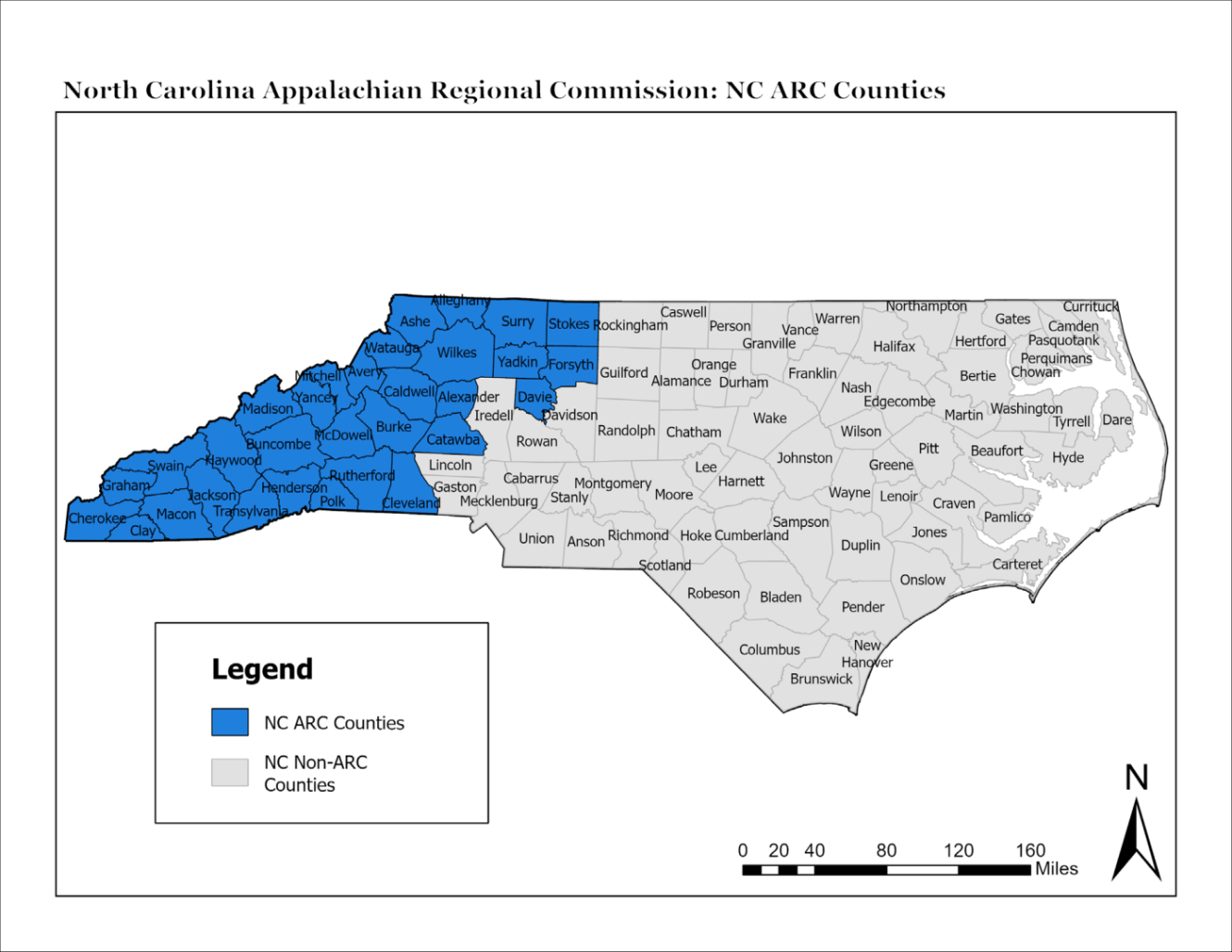
Map: North Carolina Appalachian Regional Commission Counties
ARC Economic Status
ARC’s primary objective is to help counties improve their economic development potential in order to compete with the rest of the nation and the world. The ARC uses an index-based county economic classification system to identify and monitor the economic status of Appalachian counties. The system compares each county's averages for three economic indicators—three-year average unemployment rate, per capita market income, and poverty rate—with national averages. The resulting values are summed and averaged to create a composite index value for each county. Each county in the nation is then ranked, based on its composite index value. Counties are designated as distressed, at-risk, transitional, competitive, or attainment, based on their ranking in the index.
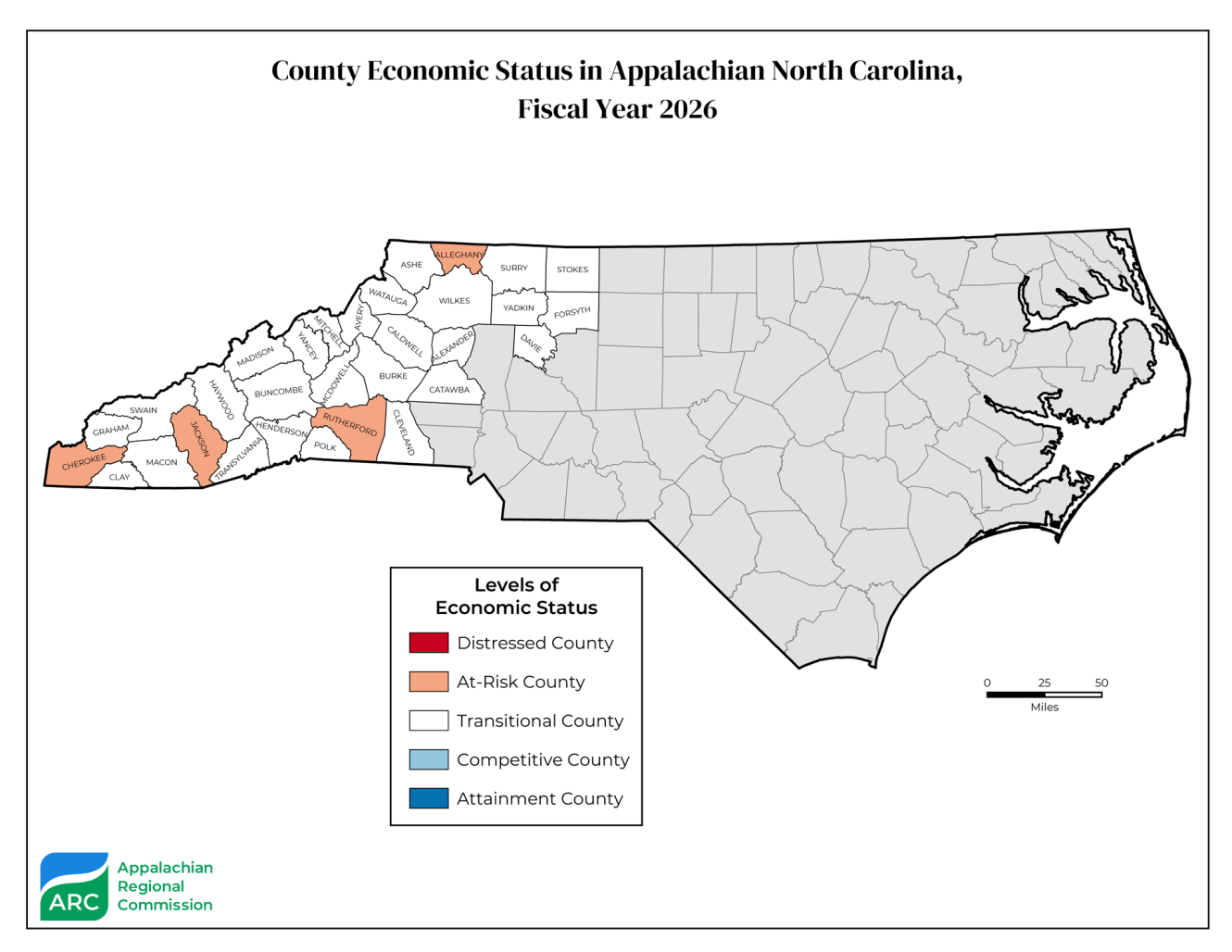
Map: NC ARC County Economic Status Designation, FY 2026
Federal, State, and Local Partners
The NC ARC Program partners with multiple organizations both at the federal, state, and local level, including nonprofits. Program staff work daily with colleagues across the Rural Economic Development Division, including the North Carolina Main Street & Rural Planning Center, the Community Development Block Grant Program, and the Rural Engagement and Investment Program. These programs provide assistance for building reuse and restoration, water and sewer infrastructure, and economic innovation in rural communities. Other NC Department of Commerce ties include all elements of business and industry development, and workforce development. Coordination also occurs with other state agencies including, but not limited to:
- The Department of Environmental Quality, which currently includes water and wastewater programs for the state, as well as other environmental programs;
- The Department of Health and Human Services, which provides rural health and child development services;
- The State Treasurer’s Office, which oversees and regulates local fiscal affairs;
- The Department of Public Instruction, which governs elementary and secondary education;
- The North Carolina Community College System which oversees 58 public, two-year institutions;
- The University of North Carolina System, which oversees 16 institutions; and
- Economic Development Partnership of North Carolina (EDPNC)
The program continues to maintain strong relationships with these federal agencies:
- The United States Department of Agriculture state and district offices that serve ARC counties;
- The Economic Development Administration’s state representative as well as the regional office in Atlanta; and
- The United States Department of Housing and Urban Development.
There is also occasional interaction with the Federal Emergency Management Agency, Environmental Protection Agency, the Small Business Administration, and staff with the National Park Service.
Program staff relies extensively on state and federal agencies for technical review and engineering support of proposed project activities and request their aid in determining project readiness, assessing if a potential project duplicates existing efforts, and for joint funding of projects and administration of ARC funds, when applicable. Close cooperative relationships also are maintained with non-profits including the Dogwood Health Trust, the North Carolina Rural Center and the Golden LEAF Foundation. Continuing contact and information sharing among the agencies and partners promotes a coordinated development effort for the state and aids in resolving problems and meeting the needs of its communities, especially in efforts to support or develop local capacity.
The six Local Development Districts (LDDs) serving North Carolina’s ARC region, as agents of their member governments, maintain constant contact with the State and provide feedback, suggest areas of concentrating efforts, and supply multicounty perspectives on issues. The LDDs also provide most of the direct technical assistance to applicants in the region. Technical assistance runs from the development of projects to the packaging of applications and in some cases, includes aid in bidding, administering, and closing out projects. The state relies heavily on input from the LDDs in developing new project directions and in soliciting input from other organizations in the region.
The 31 counties are served by six Local Development Districts (LDDs). The LDDs are:
- Southwestern Commission: Cherokee, Clay, Graham, Haywood, Jackson, Macon, and Swain counties;
- Land-of-Sky Regional Council: Buncombe, Henderson, Madison, and Transylvania counties;
- Foothills Regional Commission: Cleveland, McDowell, Polk, and Rutherford counties;
- High Country Council of Governments: Alleghany, Ashe, Avery, Mitchell, Watauga, Wilkes, and Yancey counties;
- Western Piedmont Council of Governments: Alexander, Burke, Caldwell, and Catawba counties; and
- Piedmont Triad Regional Council: Davie, Forsyth, Stokes, Surry, and Yadkin counties.
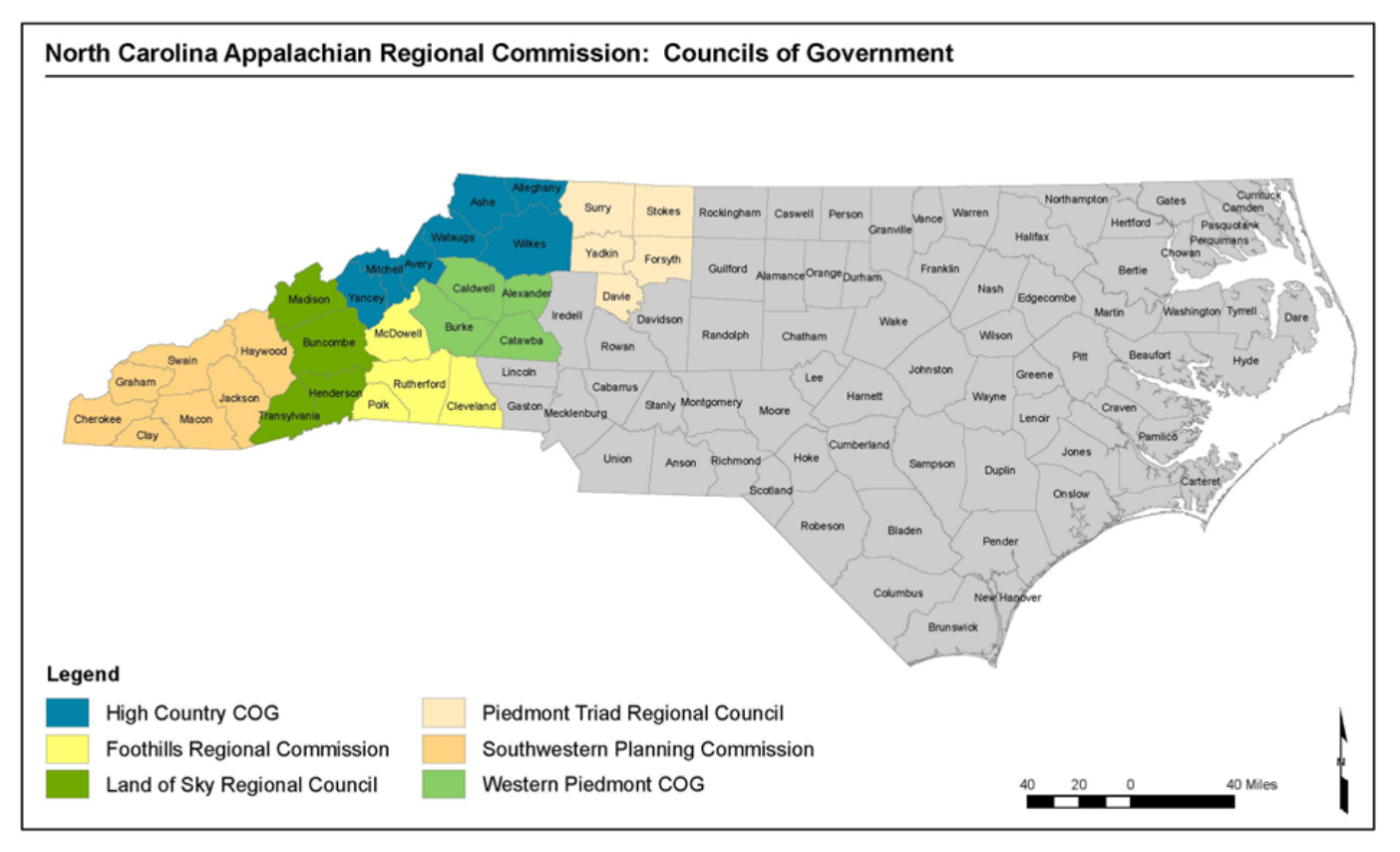
Map: Councils of Government serving the NC ARC area
Local governments’ input comes in many forms. Contacts may be made:
- Through the LDDs;
- Directly with the Governor, the Governor’ ARC Alternate, or members of the Governor’s staff;
- Through local government associations (the NC League of Municipalities and the NC Association of County Commissioners);
- Through referrals from other agencies; or
- Through advisory groups used as a source of program development (such as the Rural Infrastructure Authority).
Economic Challenges
The economic challenges facing Western North Carolina’s Appalachian region have not only been persistent in many communities but are now deepened by the impacts of Hurricane Helene. This natural disaster created new vulnerabilities particularly around infrastructure, workforce development, tourism, and local government capacity. The ARC program will work with our partners and grantees to continue to overcome these challenges which include:
Hurricane Helene
While not all NC ARC counties were directly impacted by physical damage from Hurricane Helene, the storm has had—and will continue to have—a significant effect on the broader region, particularly from an economic standpoint. Helene deepened long-standing challenges in Western North Carolina’s Appalachian region, exposing vulnerabilities across workforce development, infrastructure, tourism, and local government capacity.
The storm caused billions of dollars in damages to physical, financial, and human capital, leaving small businesses—especially in the hospitality and recreational industries—struggling to recover. Workforce shortages and skill mismatches worsened as residents faced new barriers to employment, while aging infrastructure suffered landslides, road washouts, and flooding that disrupted travel, commerce, and community life. Tourism, a foundation of the regional economy, was severely affected by trail, park, and scenic byway closures, leading to lost revenue and a perception amongst tourists that Western North Carolina is not safe for travel. Meanwhile, local governments, already constrained by limited staffing and financial capacity, confronted sharp revenue declines, mounting repair costs, and increased pressure to address housing loss and business recovery. As a result, hurricane recovery will remain a central focus in many of NC ARC’s program areas in the coming years, underscoring the need for sustained investment, coordinated recovery strategies, and resilience planning to build stronger, more sustainable communities.
Building a Skilled Workforce
Western North Carolina faces a complex and evolving set of workforce development challenges that threaten long-term economic resilience and growth. Regional workforce struggles include issues such as:
- The outmigration of young adults who leave in search of broader career opportunities;
- Persistent skill mismatch where individuals lack the specific credentials, technical skills, or certifications required by high-demand industries;
- Structural barriers that limit participation in workforce development such as broadband availability, transportation gaps, affordable childcare or lack of childcare options, substance abuse, and more; and
- An aging population.
Economic Infrastructure Challenges
Western North Carolina’s economic growth and community resilience are increasingly constrained by outdated and vulnerable infrastructure systems. The water and sewer, transportation, and broadband infrastructure that is essential to daily life and economic activity is often aging, insufficient, or ill-equipped to meet modern demands. Addressing these infrastructure challenges are critical to the long-term vitality of Western North Carolina. Strategic, place-based investments can help modernize essential systems, increase resiliency to natural hazards, and lay the foundation for sustainable economic development in all parts of the region.
Small Business Support
Establishing and supporting vibrant entrepreneurial support is vital for communities to foster small business development. Western North Carolina has a large presence of small businesses and those businesses play an important role in local economies. Hurricane Helene had a significant impact on small businesses throughout Western North Carolina. A study conducted for the Economic Development Partnership of North Carolina estimates that a direct economic loss of between $4.5-$5.0 billion to private sector businesses occurred. In response to the economic damages caused by Hurricane Helene, continued efforts to promote entrepreneurship and support small businesses as an economic development strategy are needed.
Economic Challenges for Local Governments (Local Capacity)
The impacts of Hurricane Helene in 2024 increased long-standing capacity challenges in local governments that now threaten to slow the region’s recovery and limit its resilience to future events.
One of the most immediate consequences of the storm was a sharp loss in local revenue. Closures of businesses, outdoor recreation areas, and tourism attractions led to a decline in sales tax, occupancy tax, and user fees—key revenue sources for rural counties and towns with limited economic diversification. Infrastructure damage also delayed property assessments and disrupted tax collection schedules, creating budget shortfalls that have persisted beyond the initial disaster period.
Compounding the revenue loss is the financial burden of infrastructure repair. Local governments are responsible for rebuilding damaged roads, bridges, stormwater systems, public buildings, and water and sewer infrastructure. Accessing federal or state disaster relief programs—such as FEMA Public Assistance—typically requires local cost shares or matching funds. However, many small jurisdictions lack the financial reserves to meet those requirements, leaving critical projects delayed.
At the same time, staffing and administrative capacity is stretched thin. Many rural municipalities operate with minimal personnel, with staff often wearing multiple hats. This makes it difficult to manage complex post-disaster tasks such as navigating grant applications, coordinating with state and federal agencies, overseeing engineering contracts, and complying with disaster recovery documentation. In some cases, staff burnout or turnover has further slowed progress.
To rebuild stronger and prepare for future disasters, Western North Carolina’s local governments need capacity-building resources, planning support, and technical assistance.
Economic Challenges Related to Tourism & Outdoor Recreation
Tourism and outdoor recreation are vital economic drivers in Western North Carolina, supporting hundreds of small businesses and contributing significantly to local tax bases. However, the impacts of Hurricane Helene in 2024 severely disrupted this sector, exposing deep vulnerabilities in the region’s tourism infrastructure and economic resilience. Recovery for the tourism sector in Western North Carolina is critical to overall economic recovery. Strategic investment that targets the infrastructure that enables tourism, support for tourism-dependent businesses, and coordinated efforts to restore visitor confidence are key to the recovery of this sector.
Economic Opportunities
Western North Carolina is a place rich in natural resources and talented people. A place where a strong heritage combines with modern services and opportunities to create a region with great quality of life. Vibrant cities and towns offer great places to do business. Infrastructure improvements will allow for long-term economic growth and resiliency. Advances in manufacturing allow this important sector to grow providing well-paying job opportunities and economic growth. Recovery from Hurricane Helene is making progress, and marketing campaigns to let travelers know that Western North Carolina is open are helping the tourism and outdoor recreation sectors rebound. Universities and community colleges provide educational opportunities that align with local industry needs. Emerging economic opportunities exist in the following areas:
Workforce Development
Western North Carolina needs intentional investments in workforce development which can serve as both a recovery strategy and a long-term economic opportunity. The region has the potential to strengthen its labor force, create upward mobility, and drive growth by building on existing assets and aligning education with emerging industry demands. A key opportunity is to support Career and Technical Education (CTE) across the region’s high schools and community colleges. Expanding programs like short-term credentials, apprenticeships, and customized industry training will help upskill both new and incumbent workers. Strengthening partnerships between high schools, colleges, local development districts (LDDs), employers, and economic developers can make training efforts more coordinated, targeted, and impactful.
Infrastructure
Western North Carolina’s future economic resilience and competitiveness is reliant on strategic investments in infrastructure. As the region recovers from Hurricane Helene and grapples with the long-term impacts of aging systems, there is a unique opportunity to rebuild smarter and to construct infrastructure that not only restores what was damaged but strengthens communities against future disruptions while creating new economic potential. NC ARC infrastructure investments will focus on water and sewer systems, broadband, and downtown revitalization. Regional transportation initiatives such as completing the Appalachian Development Highway System are also critical to long-term economic success.
Tourism and Outdoor Recreation
Tourism and outdoor recreation are keys to Western North Carolina’s economy, drawing millions of visitors annually to its trails, rivers, scenic byways, and charming mountain towns. In the wake of Hurricane Helene, the region now has a timely opportunity not only to rebuild what was damaged—but to reimagine a more resilient and economically vibrant outdoor economy. Strategic investment that targets the infrastructure that enables tourism, support for tourism- dependent businesses, and coordinated efforts to restore visitor confidence are key to the recovery of this sector.
Local Government Capacity
Local governments in Western North Carolina are the foundation of regional resilience and economic development. Yet many small towns and rural counties continue to operate with limited staff, tight budgets, and few resources to manage the growing complexity of disaster recovery, infrastructure investment, and long-term planning. Strengthening local government capacity is not only critical to recovery from Hurricane Helene—it represents a major economic opportunity to build more self-reliant, forward-looking communities across the region.
An opportunity is to support capacity-building for local governments through the network of Local Development Districts (LDDs). Providing LDDs with resources to help support grant writers, planning consultants, and disaster recovery coordinators can dramatically increase the ability of small municipalities to access state and federal funds, manage complex projects, and engage residents in meaningful ways.
ARC Focus for North Carolina
Governor Stein will utilize ARC resources to strengthen the region’s ability to meet the demands of the 21st century economy and to ensure communities are prepared to seize emerging opportunities. A key focus will be supporting communities still recovering from the devastating impacts of Hurricane Helene by investing in resilient infrastructure, rebuilding local capacity, and restoring economic vitality. His priorities include long-term infrastructure projects that promote job creation and commerce, helping local governments build systems that can better withstand future disruptions, and expanding workforce development through stronger partnerships between K-12 schools, community colleges, and local industry. Additionally, he is committed to improving health outcomes in rural communities by supporting projects that grow the health care sector and address persistent challenges such as substance use disorder. These investments reflect the Governor’s belief that economic development requires leadership, planning, and action—and that ARC resources are essential to helping communities across North Carolina, especially those hardest hit by natural disasters, build a more resilient future.
NC ARC Investment Opportunities (Project Types) Overview
The following are examples of types of projects Governor Stein would like to support with ARC resources. (Examples are listed by ARC Strategic Investment Goals.)
Goal 1 – Building Appalachian Businesses
Strengthen and diversify the Region’s economy through expanding economic development strategies and investments in entrepreneurship and business development.
Examples of potential projects include shared-use kitchens, co-packaging plants, small business incubators, regional agriculture markets, community loan funds, industry cluster development, small business plan competitions, and small business mentorship programs.
Goal 2 – Building Appalachia’s Workforce Ecosystem
Expand and strengthen community systems (education, healthcare, housing, childcare, and others) that help Appalachians obtain a job, stay on the job, and advance along a financially sustaining career pathway.
Examples of potential projects include career pathway program development, health care training programs, rural health care clinics, college access programs, employment supports, and workforce development programs.
Goal 3 – Building Appalachia’s Infrastructure
Ensure that the residents and businesses of Appalachia have access to reliable, affordable and resilient utilities and infrastructure in order to successfully live and work in the Region.
Examples of potential projects include downtown Wi-Fi, broadband fiber deployment, access roads, water and sewer projects that result in job creation and/or retention, industrial site development, and transportation planning.
Goal 4 – Building Regional Culture and Tourism
Strengthen Appalachia’s community and economic development potential by preserving and investing in the Region’s local, cultural heritage, and natural assets.
Examples of potential projects include local food and farm programs, downtown revitalization, regional craft and art trails, tourism development, establishment of gateway programs, regional tourism development, and outdoor recreation economy planning and development.
Goal 5 – Building Community Leaders and Capacity
Invest in the capacity of local leaders, organizations, and communities to address local challenges by providing technical assistance and support to access resources, engage partners, identify strategies and tactics, and conduct effective planning and project execution.
Examples of potential projects include regional planning, community economic development planning, local leadership development training, youth leadership development, and community engagement programs.
State Program Operating Policies
In North Carolina, the level of ARC funds requested may not exceed 50% of the total project cost, except: 1) in designated at-risk and distressed counties where the state determines the project is not feasible without the injection of a higher percentage of Appalachian dollars; and 2) in multijurisdictional projects that meet requirements set out in the Appalachian Regional Development Reform Act of 1998, which generally involve the participation of distressed counties. The level of ARC funds requested for projects in designated competitive counties may not exceed 30% of the total project cost unless the applicant provides adequate justification to meet exceptions in the ARC Code. Projects involving designated attainment counties must be multi-county in scope and meet the stringent criteria defined in the 1998 law.
Proposals for the following activities are not eligible: construction of schools, libraries, government offices, hospitals, community centers, museums, social services facilities, law enforcement facilities, or recreational facilities. However, the ARC program will consider the jobs created by these and other facilities as part of the justification for water and wastewater projects. Generally, funding is not available to cultural facilities and activities; however, activities related to development initiatives may be considered where the jobs and wealth resulting from those activities can be documented and are equivalent to the performance measures generated by more traditional economic development and entrepreneurial activities.
The state will work with the LDDs, local governments, and basic agencies to continue efforts to obligate the state’s ARC allocation in a timely manner and to achieve dual objectives of better serving applicants and more efficiently initiating ARC’s investments in North Carolina.
General Information
All application materials will be published on-line at: https://tinyurl.com/NC-ARC-Application.
Higher priority is given to projects that are deemed ready to go. To meet this requirement, the applicant should have all other funding for the project committed. Both the worth of the individual project in achieving the State’s objectives and the level of assistance needed are determined on a case-by-case basis.
Initial screening of proposals focuses on the following elements:
- Feasibility of the project approach;
- Eligibility under ARC Code and Appalachian Act;
- Consistency with State and Commission goals and strategies;
- Economic impact within the context of the region and the area to be served;
- ARC assistance is the source of last resort. As such, projects may only use ARC funds where there is no other source of funding and/or where Commission money will make a project feasible;
- Project applications must include measurable outputs and outcomes that are consistent with federal performance measurement requirements;
- Individuals and for-profit enterprises are not eligible for direct grant assistance; but may benefit from, and be served by, the investment of ARC funds.
Special provisions related to operating projects:
- ARC funding for operating projects normally will be limited to start-up costs and two years of operation (three years of assistance);
- No project will be guaranteed more than one year of support and applicants are advised that projects requesting multiple year funding generally will not be given a high priority;
- Any project requesting start-up funds should be prepared to identify the sources that will underwrite the costs after the first year of ARC support;
- Generally, continuation projects (those operating in multiple years with no appreciable changes in project design or scope) should reduce the level of ARC support by 10% of the amount of their previous grant or show other efforts to enhance the program attaining self-sufficiency;
- Operating projects also will be encouraged to propose an 18-month initial project period. Since most projects need this additional time to meet unexpected start up delays, the proposed longer performance period should help avoid the need to extend project periods to meet the first year’s objectives;
- Any project seeking continuation funding (a second or third application for assistance) will need to initiate discussions with the State’s ARC office at least a month in advance of the application submission deadline in order to determine if an application will be considered. Prior to seeking continuation consideration, the project sponsors should compile information documenting satisfactory performance in meeting the accepted output and outcome measures to support the request for continued assistance.
Decisions to consider projects for Appalachian funding are based on summary information that provides enough detail to enable the State ARC office to determine the proposal’s eligibility. Construction projects should have preliminary commitment of jobs and a preliminary engineering report prior to requesting consideration. Construction projects also must obtain the review and approval of another federal grant-financing agency, and any ARC funding consideration is contingent upon obtaining the participation of another federal agency.
Funding and Match Guidance
The state has set a general guideline that ARC assistance will not exceed $700,000 for construction projects and $300,000 for non-construction projects. Funding will constitute no more than 50% of the total project cost. However, special consideration will be given to infrastructure projects in distressed and at-risk counties. Selected projects may request up to $1,000,000 in ARC funding. Special consideration may also be given to non-construction projects with an emphasis on workforce development and education with an allowable funding amount up to $500,000. The level of ARC funds requested for projects in designated competitive counties may not exceed 30% of the project cost unless justification is provided to meet exceptions in the ARC Code. The Program reserves the right to reduce the requested funding amount in order to allocate available resources efficiently and effectively.
To comply with Congressional instructions, the matching requirements in multicounty projects will vary, depending on the designated economic status of the counties involved. Multicounty projects serving fewer than the 31 NC ARC counties will be computed based on the average of the eligible financing level for the counties involved.
Cost overruns and significant changes of project scope on previously approved ARC projects generally will not be considered for funding. Changes required by design modifications or changes that will generate additional jobs will constitute rationales for consideration of overrun requests.
ARC funds cannot supplant or diminish the level of other funds (federal, state, or local) going into the Appalachian region or the project area. ARC funds cannot replace other funds to continue a project, nor may ARC funds be used to allow the diversion of existing resources to other purposes or to reduce the amount of bonds to be sold to finance local improvements.
This application process will allow the Program to continue to be responsive to local needs while ensuring timely obligation of ARC funds.
Applicants are encouraged to work closely with other agencies involved in their project to meet the cut-off dates. Proposals involving construction should be especially aware of the time constraints and applicants should alert their engineers to strictly observe these time deadlines.
Application Process
The NC ARC Program invites applications annually, typically in March, for the upcoming federal fiscal year. This timeline may be adjusted to accommodate congressional mandates or other funding considerations.
Pre-Application Phase
The process begins with the release of a Request for Pre-Applications, published on the NC Department of Commerce website. Pre-applications are due approximately six weeks after this announcement.
Once submitted, pre-applications undergo a thorough review by a team from the Department’s Rural Economic Development Division (REDD). This team includes:
- NC ARC Program Staff
- Rural Economic Development Planners
- Main Street Program Developers
- Community Development Block Grant Administrators
This multidisciplinary team evaluates proposals based on their alignment with:
- ARC’s Strategic Investment Goals
- Governor Stein’s ARC priorities
- The potential to make a measurable economic impact in the NC ARC region
The REDD team brings deep knowledge of local challenges and opportunities and works closely with local governments and organizations throughout North Carolina’s ARC region.
In parallel, the ARC Program Manager consults with Local Development District (LDD) Executive Directors to assess regional priorities and ensure alignment with broader development strategies.
Following this collaborative review, selected applicants are invited to submit full applications. Notifications are sent via email.
Application Phase
Full applications are by invitation only and are generally due by July 31st each year. Invited applicants are required to attend an ARC Application Workshop, typically held in mid-June. This workshop is conducted in person and features presentations from both NC ARC staff and representatives from ARC headquarters, offering guidance on crafting competitive and compliant applications.
Once full applications are submitted, they are reviewed by the internal review team, which includes both state staff and LDD representatives. Applications are evaluated for:
- Consistency with ARC and state requirements;
- Alignment with key priorities, including:
- Enhancing long-term infrastructure to support commerce and job creation;
- Strengthening local government infrastructure resiliency, particularly in response to Hurricane Helene; and
- Building partnerships between local industries, K–12 schools, and community colleges to improve workforce development pipelines;
After completing the review process, recommended projects are submitted to the Governor for approval and transmittal to ARC headquarters. Final funding decisions are made by the ARC Federal Co-Chair.
Application Materials and Timeliness
The ARC Program publishes application forms and related materials on its website:
https://tinyurl.com/NC-ARC-Application.
This structured application process allows the Program to remain responsive to local needs while ensuring the timely obligation of ARC funds.
Applicants are strongly encouraged to coordinate closely with all partner agencies involved in their projects to meet critical deadlines. Construction-related proposals should be especially mindful of time constraints, and applicants should ensure that their engineers are aware of and adhere to all submission deadlines.